Check Point VPN Zero-Day Lets Ransomware Skip the Password
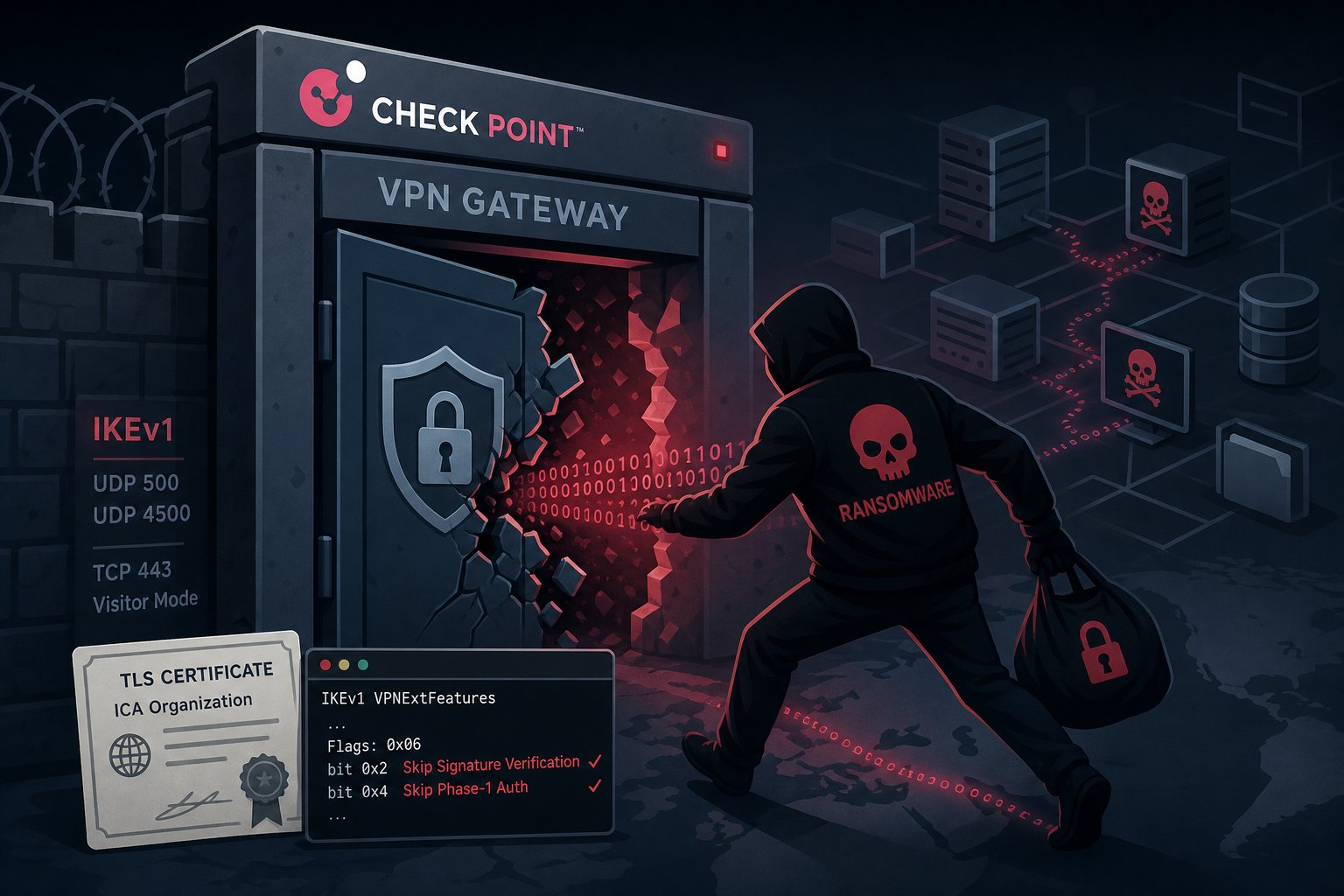
A VPN is supposed to be the locked door at the edge of your network—only the right people get in. CVE-2026-50751 is a vulnerability in Check Point's Remote Access VPN, Mobile Access, and Spark Firewall products that removes that lock entirely. Attackers don't need credentials. They don't guess or crack a password. They send a crafted packet, the gateway nods, and they're on your network.
Check Point released emergency hotfixes on June 8, 2026—but exploitation started May 7, giving threat actors a full month of undetected access before a patch existed. CISA added CVE-2026-50751 to its Known Exploited Vulnerabilities catalog the same day the fix dropped, with a federal remediation deadline of June 11. The Dutch National Cyber Security Centre followed with a warning about imminent large-scale abuse. If you have Check Point appliances in your environment and haven't patched, you are actively at risk today.
How the Bypass Actually Works
The root cause is almost elegant in a terrible way: the gateway delegates the authentication decision to the client. The vulnerable process_cert_payloads() function accepted a parameter controlling whether to validate machine certificates at all. By manipulating bytes inside the IKEv1 VPNExtFeatures Vendor ID payload—specifically toggling two flag bits (0x2 and 0x4)—an attacker instructs the gateway to skip both signature verification and phase-1 message authentication. The gateway then confirms a successful session for a user it never actually verified.
Researchers at watchTowr put it plainly: "The gateway lets the client choose how carefully to check its credentials. The client chooses 'don't bother'. The gateway doesn't bother." An attacker needs only a valid username (obtainable via enumeration) and the ICA organization string, which is readable from the gateway's public TLS certificate. With those two items, an attacker can forge a self-signed certificate with a garbage signature, present it, and receive a confirmed VPN session. The attack works on UDP 500/4500 and TCP 443 (the Visitor Mode fallback used in restrictive networks), covering three of the four supported authentication modes.
There is a detection signal worth noting: gateways log non-Check Point clients as vendorid=0 ... not a Check Point peer even while simultaneously honoring the spoofed authentication flags. A successful-looking session following that log line is a concrete indicator of compromise to investigate.
Which Products and Versions Are Exposed
The vulnerability spans nine Check Point release branches: R80.20.X, R80.40, R81, R81.10, R81.10.X, R81.20, R82, R82.00.X, and R82.10. Four of those—R80.20.X, R80.40, R81, and R81.10—have reached end-of-support and received no patch. Organizations still running those versions have no supported fix other than an emergency upgrade. For supported releases, hotfixes are documented in Check Point's support portal under SK185033 and SK185035.
The vulnerability requires a specific configuration to be exploitable: the gateway must use the deprecated IKEv1 key exchange protocol, accept legacy remote access clients, and not require machine certificates. Organizations that have enforced IKEv2-only authentication and mandatory machine certificates are not vulnerable. The problem is how many environments keep IKEv1 enabled as a compatibility fallback—that decision is now the entry point.
Qilin Ransomware Is Already In the Door
At least one confirmed post-compromise incident has been attributed with medium confidence to a Qilin ransomware affiliate. Qilin is not a secondary actor: it emerged in August 2022 as a ransomware-as-a-service operation (originally called "Agenda") and by Q1 2026, Check Point Research reported that Qilin claimed more victims than the bottom fifty ransomware groups combined. Past targets include Nissan, Synnovis (whose breach disrupted NHS blood bank services in the UK), and Lee Enterprises.
In the observed intrusions, attackers deployed Linux ELF ransomware binaries after gaining access, used Rclone for data exfiltration, and communicated via the Tox protocol. A notable operational detail: the attackers geolocated their infrastructure to match their victims' geography—a technique designed to blend into geo-based allow-lists and avoid detection. Investigators also uncovered a companion vulnerability, CVE-2026-50752, which enables man-in-the-middle attacks on site-to-site VPN configurations under certain conditions.
What to Do Right Now
- Patch immediately. Apply the hotfixes from SK185033 and SK185035 if your version is still supported. If you're on an end-of-support branch, an emergency upgrade is the only real option.
- If patching today isn't possible, mitigate. Disable legacy remote access client support, enforce IKEv2-only authentication, require machine certificates for gateway connections, and enable IPS with the latest signatures.
- Set your exposure window to May 7. Run a forensic audit of VPN access logs from May 7, 2026 forward. Check Point has published nine malicious IP indicators and two MD5 hashes for the ELF payloads dropped during post-exploitation.
- Turn off deprecated protocols everywhere. IKEv1 was deprecated for good reasons that predate this specific flaw. If your security stack has legacy protocols enabled as a fallback, this incident is the case study for disabling them.
CVE-2026-50751 is not an isolated failure—similar ransomware-linked campaigns have exploited perimeter VPN vulnerabilities in Palo Alto, Fortinet, and F5 appliances throughout 2026. The pattern is consistent: perimeter VPN devices are the highest-value targets because compromising them means bypassing everything inside the perimeter at once. At Falcon Internet, watching for authentication anomalies at the gateway layer—not just application-layer events—is part of why our 24x7x365 NOC monitoring is structured the way it is.