
Grok 4.5 Is Here: SpaceX Merges AI Giants and Drops a Cursor-Trained Frontier Model
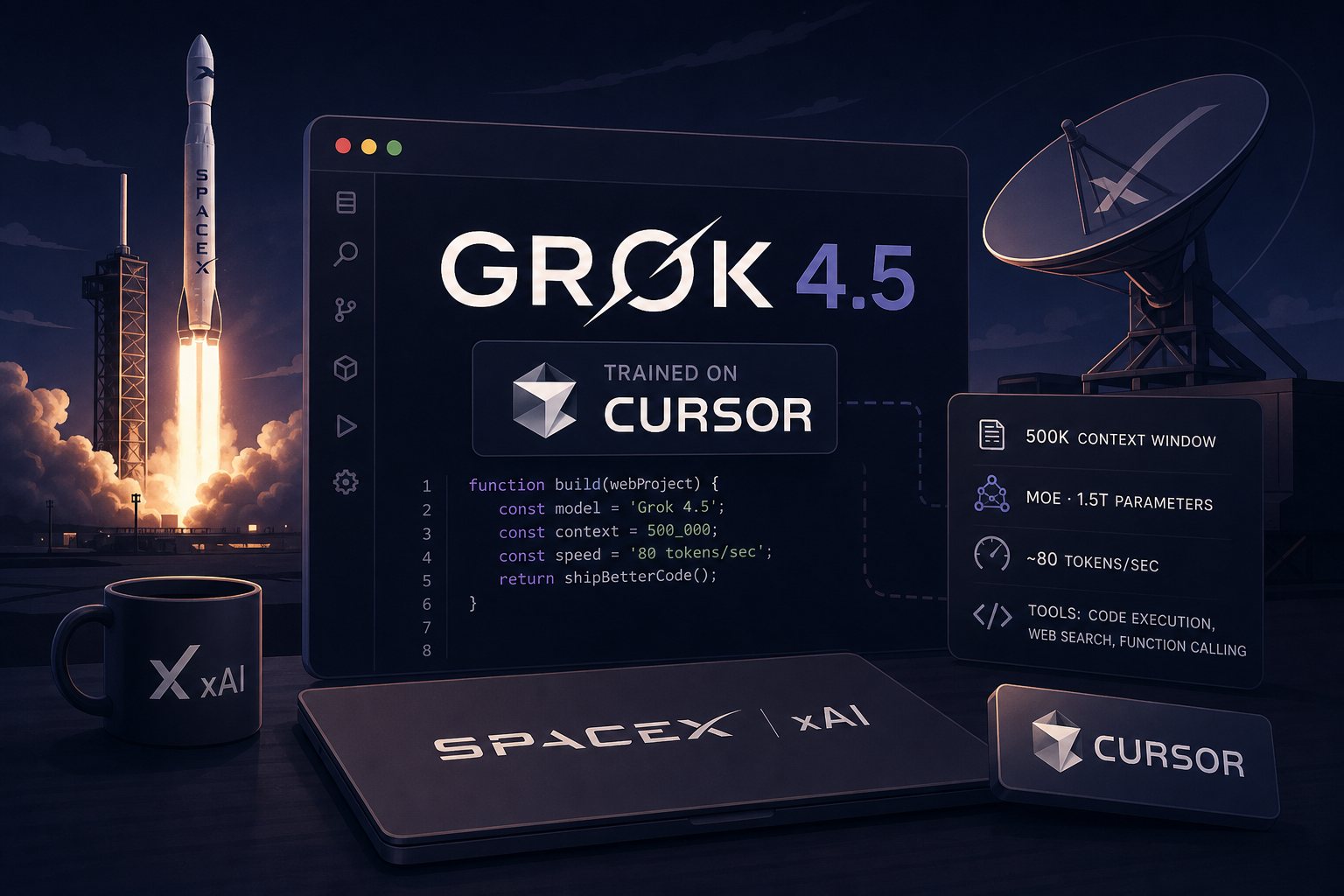
Three frontier AI labs dropped major models in the span of roughly 36 hours this week. OpenAI finished opening GPT-5.6 to the public. Anthropic brought back Fable 5 after its government-mandated pause. And SpaceXAI — the company that results from Elon Musk's earlier merger of SpaceX and xAI — quietly launched what may be the most interesting release of the bunch: Grok 4.5, its first model built with training data from Cursor, the AI IDE it is in the process of buying for $60 billion.
The backstory: SpaceX is buying Cursor
Back in April 2026, SpaceX signed an option to acquire Anysphere — the company behind Cursor — with a reported $10 billion walk-away fee. On June 16, the full deal was announced: a $60 billion all-stock transaction, pegged at roughly 15× revenue, that will make Cursor a wholly owned SpaceX subsidiary when it closes in Q3 2026. SpaceX, which had already merged with xAI earlier this year, said the two companies had spent recent months building a shared AI model that would power both products. Grok 4.5 is that model's first public release.
That context matters if you are evaluating AI coding tools for web projects. Cursor's position as the dominant AI-augmented IDE means this isn't a new model competing for attention on a leaderboard — it's a new model embedded in the tool millions of developers already have open all day.
What Grok 4.5 actually is
Under the hood, Grok 4.5 runs on SpaceXAI's V9 foundation model — a 1.5-trillion-parameter mixture-of-experts architecture trained on tens of thousands of NVIDIA GB300 GPUs. The model targets three use cases: software engineering, knowledge-intensive tasks like legal and financial analysis, and agentic workflows where the model takes multi-step actions with minimal hand-holding.
Practical specs for developers:
- Context window: 500,000 tokens — large enough to hold an entire mid-size codebase in a single prompt
- Pricing (standard): $2 per million input tokens, $6 per million output tokens; cached input drops to $0.50/million (a 75% discount)
- Pricing (premium, higher speed): $4/$18 per million tokens
- Reasoning: Configurable at low, medium, or high effort (default: high)
- Tools included: Function calling, web search, X search, code execution
- Runs at: Roughly 80 tokens per second
Availability at launch covers Cursor, Grok Build, the xAI API console, plus model gateways including OpenRouter, Vercel, Cloudflare, Snowflake, and Databricks Mosaic. One significant gap: Grok 4.5 is not yet available in the EU, either through the API console or Cursor's UI. SpaceXAI says EU access is expected in mid-July.
How the benchmarks actually look
SpaceXAI claims the #1 spot on its own SWE marathon leaderboard, and Elon Musk called the model "better than expected." The independent picture is more nuanced but still respectable. Artificial Analysis ranks it #4 overall on its Intelligence Index, behind Fable 5, GPT-5.6 Sol, and Opus 4.8. On Terminal-Bench 2.1, Fable 5 edges it out (84.3% versus 83.3%). On SWE-Bench Pro — the closest thing to a real-world software engineering benchmark — Grok 4.5 resolves tasks using an average of 15,954 output tokens, compared to 67,020 for Opus 4.8. That 4.2× token gap doesn't mean Grok 4.5 does better work; it means it does comparable work far more concisely, which translates directly into lower API costs for agentic pipelines.
The honest summary: this is a frontier-class model that won't consistently top every leaderboard, but it earns its place at the table and does it at a price point that undercuts most comparable options.
Why this matters for SMBs running websites
If your team uses Cursor to write PHP, debug WordPress child themes, maintain a Laravel app, or build custom integrations, you now have a new first-class model option inside the tool itself — one tuned specifically on the kinds of software engineering tasks those workflows involve. The 500K context window is large enough to load a reasonably complex WordPress plugin plus its test suite without chunking.
The token-efficiency advantage matters at scale. A developer running agentic code-review passes, automated test generation, or overnight refactoring jobs against your codebase will burn significantly fewer tokens per task than with some alternatives — which keeps AI-assisted dev costs predictable.
One practical caution: if you or your team are in the EU, you will need to wait until mid-July before Grok 4.5 is accessible, and you should double-check your Cursor plan tier to confirm the model is available to you before building workflows around it.
The bigger picture
Three top-tier models in 36 hours is not a coincidence — it reflects labs racing to capture enterprise tooling decisions before customers lock in. For web teams deciding which AI coding assistant to standardize on, this week was genuinely clarifying: all three major labs now have competitive frontier models available, pricing has converged in the $2–$5/million input token range, and the differentiators have shifted to context length, agentic reliability, IDE integration, and token efficiency.
We have watched these evaluation cycles play out a few times now: teams that pick a model based on a single benchmark frequently switch within six months when a new release reshuffles the rankings. The more durable question is which tooling fits your workflow, your budget, and your stack — and then stress-tests it on your actual codebase rather than on synthetic benchmarks.