Two ModSecurity Flaws Let Attackers Slip Payloads Past Your WAF
If you're running ModSecurity on Apache or NGINX — and a large fraction of web hosting environments are — there's a patching task with your name on it. Two newly disclosed vulnerabilities in ModSecurity versions up to and including 3.0.15 let attackers craft HTTP requests that look clean to the WAF but carry active attack payloads all the way to the backend application. The fix is version 3.0.16, released late June 2026. It requires an intentional upgrade; the patch is already shipping.
What ModSecurity Does, and Why Bypassing It Matters
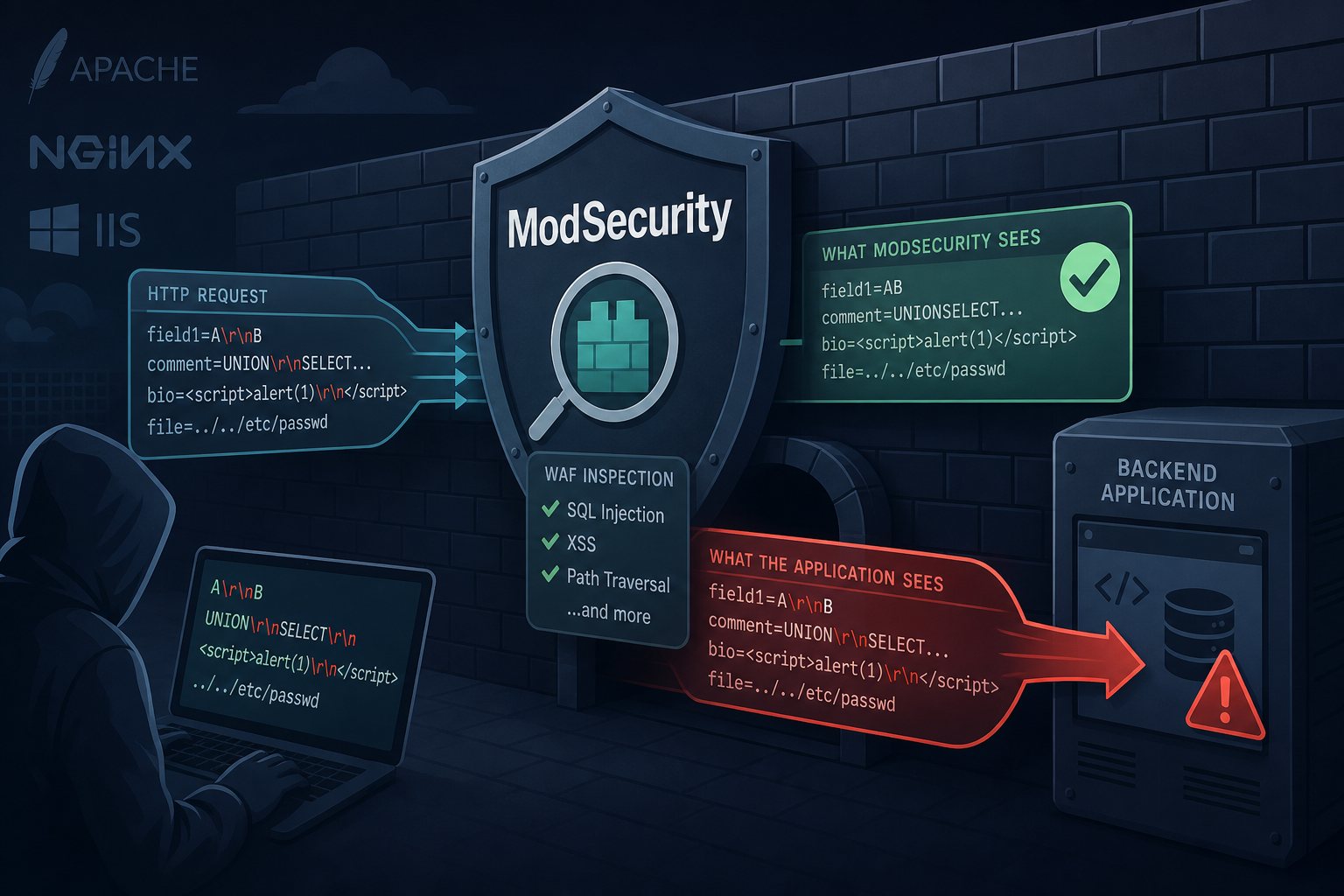
ModSecurity is the de facto open-source web application firewall engine, maintained under the OWASP project and deployed as a loadable module for Apache, NGINX, and IIS. In most managed hosting environments it runs alongside rulesets like the OWASP Core Rule Set (CRS), inspecting every inbound HTTP request for SQL injection, XSS, path traversal, and hundreds of other attack patterns before the request ever reaches PHP or your application code.
The fundamental assumption underpinning a WAF is that what the firewall sees and what the application sees are the same request. These two vulnerabilities break that assumption. When an attacker can send a request that ModSecurity reads one way and your PHP application reads another, every rule in your WAF ruleset becomes negotiable.
CVE-2026-52747: The Multipart Blind Spot
The higher-severity flaw lives in ModSecurity's multipart/form-data parser. When a form field contains embedded carriage-return and line-feed characters — \r\n sequences — the parser quietly strips them before handing the data to the inspection engine. A payload like A\r\nB becomes AB by the time ModSecurity's rules evaluate it. The backend application, however, receives the original byte sequence intact.
This matters because many WAF rules match on specific character sequences. An attacker who knows the target rule can split a payload across embedded newlines, making the malicious string unrecognizable to the WAF while the application sees and executes it in full. SQL injection and cross-site scripting payloads are natural candidates for this treatment. The vulnerability is rated high severity and affects any server running ModSecurity 3.0.15 or earlier on any architecture — 32-bit or 64-bit.
CVE-2026-52761: The 32-Bit Transform Bug
CVE-2026-52761 is rated moderate severity and has a narrower blast radius: it only affects ModSecurity on i386 (32-bit) architectures. The t:utf8toUnicode transformation — used by many CRS rules to normalize Unicode-encoded attack strings before inspection — calculates how many bytes to process using a sizeof() call on a pointer type. On a 32-bit system, that evaluates to 4 bytes. Everything beyond byte four goes uninspected.
An attacker targeting a 32-bit server can pad the front of a payload with innocuous characters and bury the attack string past the five-byte mark, evading any rule that relies on Unicode normalization to catch it. Modern server deployments are predominantly 64-bit, where pointer size is 8 bytes, so practical exposure is limited — but 32-bit environments do persist in older VPS deployments and some embedded appliances.
How to Check Your Version and Upgrade
Both flaws are fixed in ModSecurity 3.0.16. To check what you're running on a Debian or Ubuntu system:
apt show libmodsecurity3 | grep Version
On RHEL, AlmaLinux, or Rocky Linux:
rpm -q mod_security
If your package manager hasn't yet caught up to 3.0.16 — package pipeline lag is common — the OWASP ModSecurity project publishes signed source releases at github.com/owasp-modsecurity/ModSecurity/releases. After upgrading, restart the web server and confirm the new version is reflected in your error logs or a modsec_audit.log startup entry before considering the job done.
One important detail: the OWASP Core Rule Set (CRS) is a separate package from libmodsecurity itself. Upgrading the engine does not upgrade the ruleset, and vice versa. Check both independently, because an outdated CRS against a patched engine (or the reverse) leaves partial coverage.
The Larger Point About WAF Trust
Parser-divergence attacks — where the WAF and the application disagree on what a request contains — are not new to ModSecurity's history. Chunked-encoding confusion, HTTP/2 header normalization gaps, and content-type parsing mismatches have all produced similar bypasses in the past across multiple WAF products. The specific mechanisms change; the class of vulnerability does not.
A WAF is a probabilistic defense, not a mathematical guarantee. It inspects based on its own parser's view of reality, and any gap between that view and the backend's is potentially exploitable. This is exactly why WAFs work best as one layer in a stack: paired with parameterized queries and prepared statements at the database layer, input validation inside the application, a locked-down file system, and egress monitoring to catch exfiltration that got through inspection.
At Falcon Internet, our 24x7x365 NOC monitoring includes watching WAF audit logs for parsing anomalies — unusual multipart boundary patterns, high ratios of blocked-then-immediately-retried requests, content-type mismatches — because WAF bypass attempts often leave traces even when they succeed at the firewall layer. Upgrading to ModSecurity 3.0.16 closes CVE-2026-52747 and CVE-2026-52761 specifically. Layered defense handles whatever comes next.