SonicWall SMA1000's Third Zero-Day Chain: Patch Now — Then Check What July Left Behind
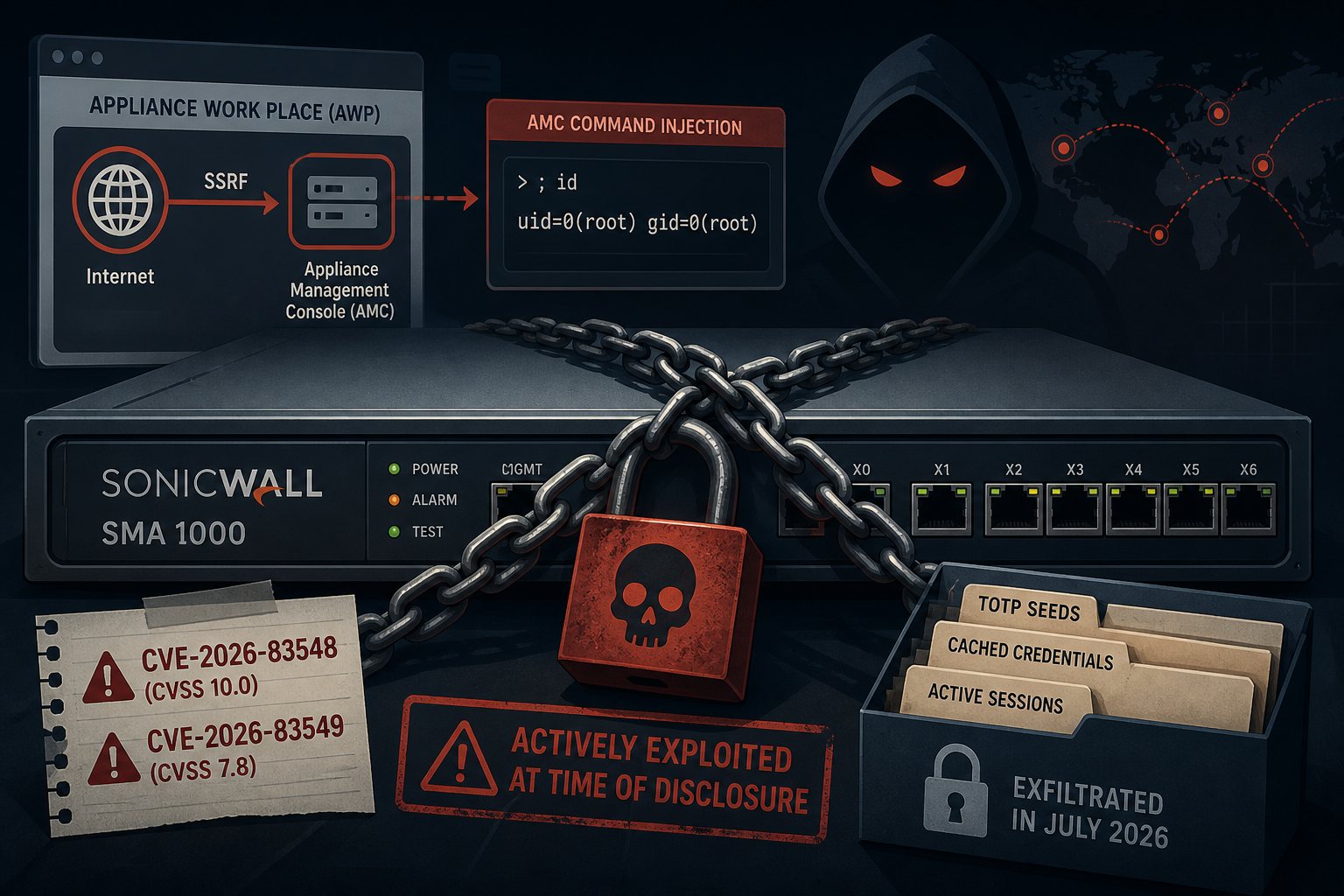
On September 1, 2026, SonicWall published security advisory SNWLID-2026-0016 disclosing two actively exploited zero-days in its SMA1000 series remote-access appliances. That phrase “actively exploited at time of disclosure” is as bad as it gets: attackers were already inside before defenders had a patch in hand. CISA added both CVEs to its Known Exploited Vulnerabilities catalog immediately and set a Federal patch deadline of September 5, 2026 — today. If you run SMA1000 hardware, that window is now closed. Here’s what happened, why the pattern matters, and why the fix is only half the job.
The Chain That Gets Attackers In Without a Password
The September chain pairs two flaws for maximum effect. CVE-2026-83548 (CVSS 10.0) is a pre-authentication server-side request forgery (SSRF) in the Appliance Work Place interface. The root problem: the Work Place endpoint is designed to serve remote users, but under a specific set of crafted HTTP parameters it can be coaxed into acting as an unintended forward proxy, tunneling requests directly to the Appliance Management Console (AMC) — a component that is supposed to be reachable only by administrators on a protected network segment. SonicWall calls this a “confused-deputy” condition.
That SSRF by itself wouldn’t be catastrophic if the AMC had nothing interesting to offer an anonymous connection. Enter CVE-2026-83549 (CVSS 7.8): an OS command injection flaw in the AMC component caused by improper neutralization of special elements. In isolation, it requires authenticated administrator access — a meaningful barrier. But when an attacker routes requests through the SSRF in CVE-2026-83548, the authentication check effectively disappears. The result is unauthenticated, remote code execution on the appliance at OS level, requiring no credentials and no prior foothold. Affected models are the 6210, 7210, and 8200v running firmware 12.4.3-03453 or earlier, or 12.5.0-02835 or earlier. The fixes are platform hotfixes 12.4.3-03526 and 12.5.0-02952.
Pattern Problem: This Is the Third Rodeo
If this feels familiar, it should. In December 2025, SonicWall disclosed CVE-2025-40602, a SMA1000 zero-day attackers were chaining to gain root privileges. In July 2026, the same appliance family was hit again: CVE-2026-15409 and CVE-2026-15410, another SSRF-to-command-injection pair at maximum severity, exploited in the wild by the INC Ransomware operation. Now September brings a structurally identical chain — same appliance family, same general technique, third active exploitation event in under nine months.
Three critical zero-day chains against the same product line in nine months is a pattern, not a streak of bad luck. SonicWall has not published indicators of compromise (IoCs) for the September chain at this writing, which makes forensic hunting harder. Defenders who have been following the vendor’s patch bulletins in good faith are operating with less information than they need.
The Part a Hotfix Can’t Reach
The September advisories are urgent. But for organizations whose SMA1000 appliances were reachable during the July 2026 window, there is a second problem the hotfix does not address at all.
During the July exploitation wave, INC Ransomware operators — who have claimed more than 885 victims — used their foothold on compromised appliances to extract cached credentials, active session databases, and Time-Based One-Time Password (TOTP) seed configurations. TOTP seeds are the shared secrets from which authenticator apps derive time-based codes. An attacker who holds your TOTP seeds can generate valid MFA codes indefinitely, from any device, without interacting with your network at all. Applying the September hotfix closes the entry point those attackers used. It does nothing to revoke seeds that left the appliance weeks ago.
The INC operators also deployed artifacts worth hunting: the KNUCKLEBALL post-exploitation script, Suo5 proxy tunnel signatures, and the ORANGETAIL web shell. A patched appliance that still hosts a web shell is not a remediated appliance.
What to Do Right Now
- Apply the hotfix immediately. Upgrade to platform hotfix 12.4.3-03526 or 12.5.0-02952. There are no workarounds for CVE-2026-83548 or CVE-2026-83549; patching is the only fix.
- Check your exposure window. If your SMA1000 management interface was internet-accessible at any point since July 14, 2026 (the first SSRF/injection chain), treat the appliance as potentially compromised regardless of whether you saw alerts.
- Rotate all credentials the appliance touched. VPN user passwords, admin credentials, any service accounts authenticated through the appliance.
- Invalidate and re-provision MFA. Do not simply reset passwords. Regenerate TOTP seeds for every user enrolled in MFA on the appliance. Until seeds are rotated, stolen material remains live.
- Hunt for artifacts. Search for KNUCKLEBALL script signatures, Suo5 tunnel patterns, and ORANGETAIL web shell indicators on any appliance that was potentially exposed during the July window.
- Restrict AMC access. The AMC interface should never be reachable from the public internet. Confirm it is bound to a management VLAN or loopback and protected by firewall rules, independent of any VPN state.
The Bigger Picture
Network edge appliances — SSL VPN gateways, remote access concentrators, firewall management interfaces — are structurally dangerous targets. They sit between the internet and your internal network, they authenticate users so they function as credential concentrators, and they are often opaque to standard endpoint detection tools. When they go, everything behind them is at risk. The SMA1000’s track record over the last nine months is a concrete argument for treating edge appliance patch cycles at the same priority level as production server patches, not as a quarterly maintenance item.
At Falcon Internet, appliance-level firmware is part of the same 24x7x365 NOC monitoring loop as server patches — because an edge device that slips a patch cycle for a few weeks is not just a vulnerability, it’s an open door sitting between your users and everything they trust.