CVE-2026-76461: Cisco’s Email Security Box Gets Rooted by Email
On September 14, 2026, Cisco published an emergency advisory for CVE-2026-76461, a CVSS 9.8 zero-day in the email-parsing logic of Cisco AsyncOS Software for Cisco Secure Email Gateway. By the time the advisory went live, attacks were already underway. CISA added the flaw to its Known Exploited Vulnerabilities (KEV) catalog the same day—and set a patch deadline of September 17, 2026.
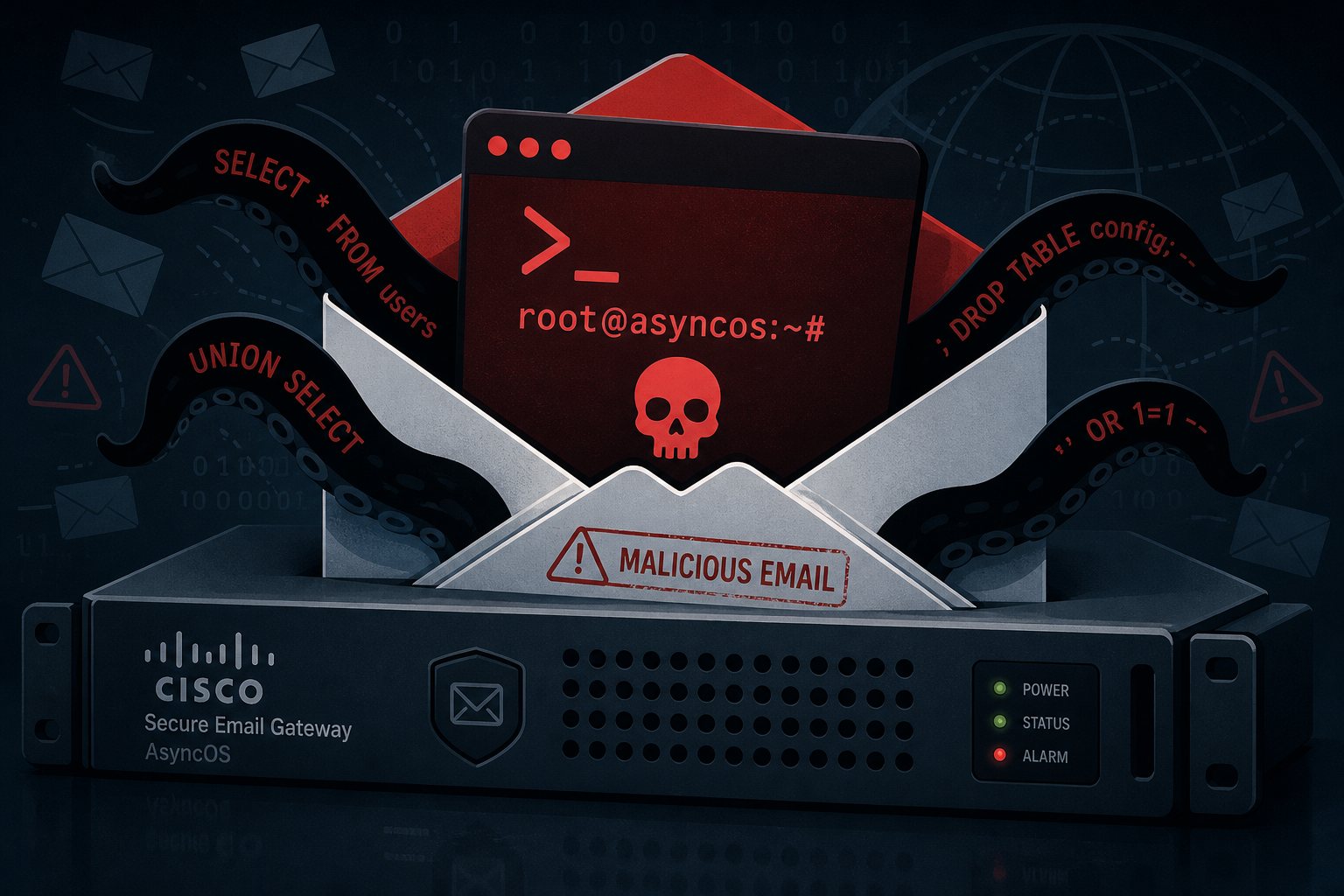
The mechanism is almost cruel in its irony: an appliance whose entire purpose is to screen inbound email for malicious content can be compromised by a malicious email, and the attacker ends up running arbitrary commands as root on the underlying operating system. No credentials. No user interaction. Just a crafted message and a shell.
How the Attack Works
The vulnerability lives in insufficient input validation inside the email-parsing pipeline. When AsyncOS processes an inbound message, it passes certain header or body fields toward an internal SQL layer. Because the software does not adequately sanitize those inputs before interpolating them into SQL statements, an attacker can embed a payload that escapes the SQL context—a textbook SQL injection (CWE-89)—and escalate that foothold to OS command execution with root privileges.
The CVSS vector is CVSS:3.1/AV:N/AC:L/PR:N/UI:N/S:U/C:H/I:H/A:H. Translated: the attack is remote, low complexity, requires zero privileges, and demands no victim interaction. An internet-facing email gateway is, by definition, designed to accept email from the entire internet. You cannot reduce the attack surface with firewall rules without also stopping legitimate mail.
Affected Versions and Patches
The flaw affects both physical and virtual Cisco Secure Email Gateway appliances regardless of configuration. Affected AsyncOS branches and their fixed versions:
- 15.5 and earlier — fixed in
15.5.5-014 - 16.0 — fixed in
16.0.4-302 - 16.5 — fixed in
16.5.0-780
Cisco confirms there are no workarounds. No configuration change, no WAF rule, and no filtering policy can meaningfully reduce exposure while email keeps flowing. The only fix is patching.
What Attackers Are Doing With It
Cisco’s Product Security Incident Response Team confirmed active exploitation after the flaw surfaced in a TAC support case—a customer was already compromised when Cisco began investigating. That sequence, discovery via a victim rather than a researcher, is the signature of a true zero-day. Attackers knew before Cisco did.
No public proof-of-concept has been released, and Cisco has not attributed the attacks to a specific threat actor. That is only marginally reassuring. The absence of a public PoC means the people currently exploiting this developed their own, which suggests meaningful skill. When PoC code does appear publicly—typically within days of a high-severity Cisco advisory—attack volume will climb sharply.
Root access on a Secure Email Gateway is particularly damaging. The attacker now controls the appliance handling all inbound and outbound mail. From that position they can silently intercept messages, harvest credentials arriving in email, disable filtering to enable follow-on phishing against internal users, or pivot into adjacent network segments that implicitly trust the gateway. The email security layer becomes the attack path.
Who Is at Risk
Cisco Secure Email Gateway (formerly Cisco Email Security Appliance) is widely deployed at mid-size organizations running on-premises or hybrid email infrastructure—law firms, healthcare offices, financial services companies, manufacturing operations, and managed service providers. Virtual appliances deployed inside VMware, Hyper-V, or KVM environments are equally affected; the hypervisor layer provides no protection.
If your organization filters email through a Cisco gateway—rather than relying entirely on a cloud-hosted service like Microsoft 365 Defender or Google Workspace—check your AsyncOS version today.
What to Do Right Now
- Identify your AsyncOS version. Log into the management interface, navigate to System Administration → System Upgrade, or run
versionat the CLI prompt. - Apply the patch immediately. Download and install 15.5.5-014, 16.0.4-302, or 16.5.0-780 from Cisco Software Downloads. Do not wait for a scheduled maintenance window—this severity breaks that policy.
- Review gateway logs for anomalies. Look for SQL-like content in parsed mail header fields, unexpected process spawning from the mail-parsing daemon, or outbound connections from the gateway to unfamiliar external IPs. CISA’s KEV catalog entry links to Cisco’s advisory, which includes suggested indicators of compromise.
- Assume compromise if patching was delayed. Root access is routinely used to install backdoors. If your gateway was internet-exposed and unpatched between disclosure (September 14) and today, patch first—then treat the appliance as potentially compromised and begin your incident-response process. Patching alone does not evict a threat actor already present.
- Audit who can access the management interface. Restrict management access to dedicated admin networks and VLANs where possible, to limit lateral-movement options if an attacker is already inside.
The Pattern Behind the Headlines
Security infrastructure—firewalls, email gateways, VPN concentrators, network appliances—is often patched on a slower cycle than the servers behind it, on the logic that “it’s a security box, it’s probably fine.” The pattern of 2026 argues otherwise. N-able N-central, SonicWall SMA1000, and now Cisco Secure Email Gateway: perimeter devices hardened by reputation but soft in practice have become a preferred initial-access vector precisely because defenders treat them differently from everything else.
At Falcon Internet, security appliances—our own and those in the environments we manage—follow the same update discipline as application servers: firmware and software releases get priority scheduling, not a spot on the next quarterly review. The assumption that the box protecting something doesn’t itself need protecting is how attackers get root and stay undetected for months.