CVE-2026-115731: exploited Puppet Server flaw exposes CA signing key
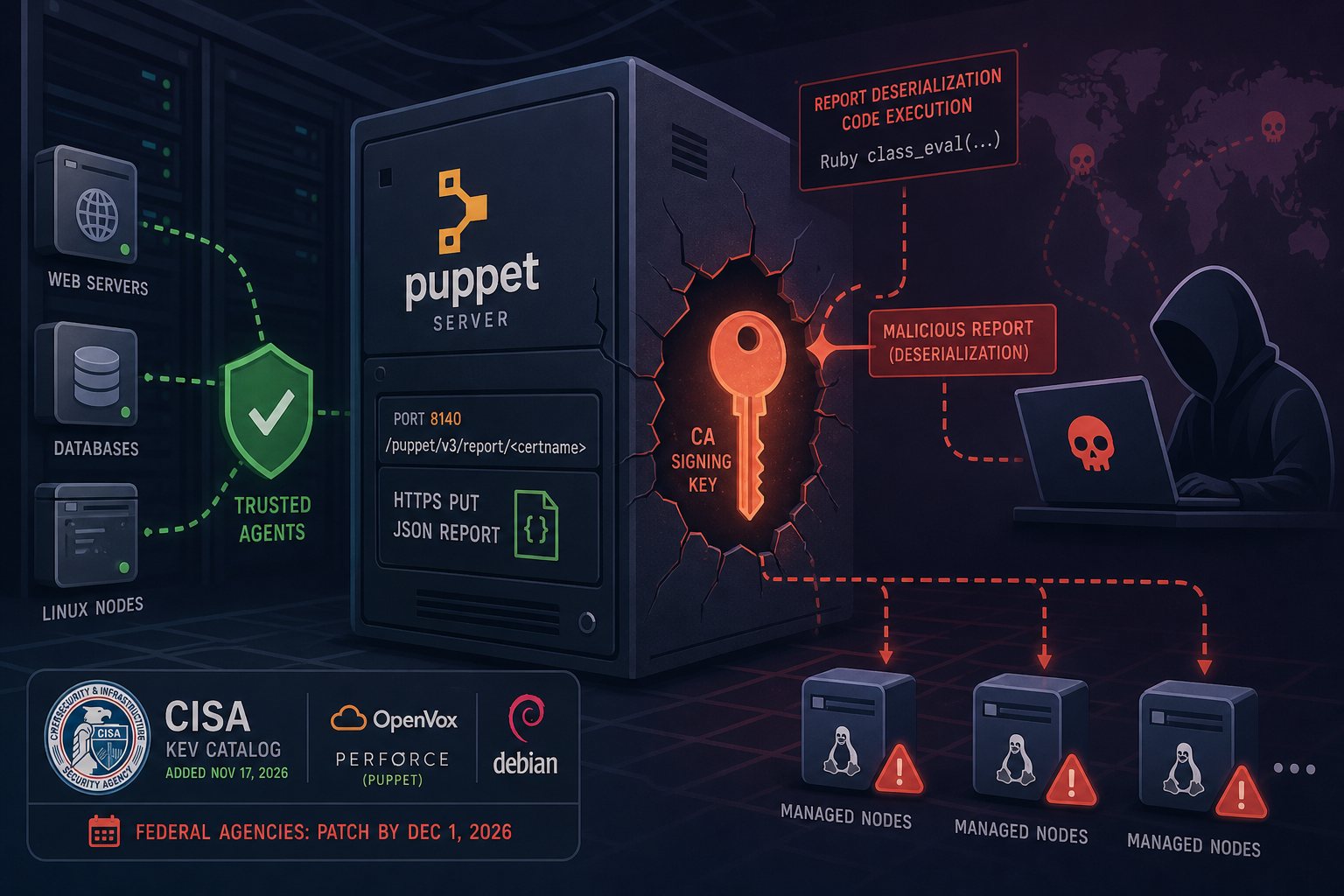
CISA added CVE-2026-115731 to its Known Exploited Vulnerabilities catalog on November 17, 2026. The flaw is in the report-processing code that Puppet Server uses, and it lets any machine holding a CA-signed agent certificate run code on the server. Perforce and the OpenVox project shipped fixes on November 3. Federal civilian agencies have until December 1 to patch.
Puppet is common at companies that manage more than a handful of Linux servers, including web and database fleets, and at MSPs that run those fleets for clients. The Puppet server holds the certificate authority every managed node trusts, plus catalogs that often carry database passwords and API keys. Code execution on that one machine reaches every host it manages.
Report deserialization runs code as the puppet user
After each run, an agent sends a JSON report to the server with an HTTPS PUT to /puppet/v3/report/<certname> on port 8140. According to the OpenVox advisory (GHSA-ffr6-rwpm-p5wq), the server reads a type name supplied in the report's event data and instantiates it, and that path ends in a Ruby class_eval call. A crafted report executes arbitrary Ruby as the puppet service account.
That account can read the CA signing key. The advisory says an attacker holding the key can sign certificates with both serverAuth and clientAuth usages, which in some orchestration setups leads to command execution on managed hosts. Perforce's own description says a successful attack could expose the signing key and let an attacker change the software or configuration sent to managed systems.
The CVSS 4.0 base score is 9.4. CISA classifies it under CWE-502 (deserialization of untrusted data) and CWE-94 (code injection). Alain Rödel of Neodyme reported it.
Autosign makes the attack unauthenticated
The exploit needs a signed agent certificate. On a server with autosign enabled and no verification of incoming requests, an attacker can submit a certificate request, receive a signed certificate, and send the malicious report. CISA's catalog entry names this condition directly. Autosign is common where servers are built automatically from templates or cloud images.
Without autosign, the attacker needs the certificate and private key from a node that is already enrolled. Any agent host that has already been compromised, such as a web server running an unpatched CMS plugin, provides one.
Fixed versions for Puppet, OpenVox and Debian
- Puppet Enterprise 2026.0.1, 2025.12.1 and 2023.8.13. Affected: 2026.0.0, 2025.0.0 through 2025.12.0, and 2023.8.0 through 2023.8.12.
- Puppet Core 9.1.3 and 8.22.2.
- OpenVox Server 9.2.0 and 8.18.0. Affected: 9.1.0 and earlier, 8.17.0 and earlier.
- OpenVox Agent 9.3.0 and 8.32.0.
- Debian
puppet-agent8.10.0-5+deb13u1 for trixie (DSA-6608-1) and 7.23.0-1+deb12u1 for bookworm LTS (DLA-4884-1). Debian unstable was still unfixed when we checked.
The vulnerable code lives in Puppet's Ruby library, which Puppet Server loads, so OpenVox shipped new agent packages alongside the server packages. Patch the server first, since that is where the code runs. Perforce stopped publishing open source Puppet builds in early 2025. Anyone still running those last community packages will not get a fix and should move to OpenVox or Puppet Core.
Exploitation evidence so far
CISA has not published details of the attacks behind its listing, and no indicators of compromise are public beyond the proof of concept. That proof of concept is a working malicious report included in the OpenVox advisory; it creates /tmp/pwned. On November 4 a Reddit user reported tracing activity in their fleet back to this CVE after finding a badly misconfigured CA. That account has not been independently confirmed. With a KEV listing and public exploit code, any unpatched server reachable on port 8140 is a target.
CVE-2026-115732 lets lookalike certificate names impersonate nodes
The same releases fix CVE-2026-115732, a hostname authorization bypass in the trapperkeeper-authorization library. The ACL code compared domain labels without comparing how many there were, so a certificate for evil.web01.example.com matched rules written for web01.example.com. With autosign on, an attacker can request a lookalike certificate and pull the target node's catalog, including any secrets in it, or submit false facts for that host. Perforce rates it 9.0; the OpenVox advisory scores it 9.5. As of November 18, CISA's catalog lists only CVE-2026-115731.
After upgrading, review any custom auth.conf rules. Rules that relied on the old matching behavior will start denying requests.
Checking a Puppet server for signs of compromise
Run these on the Puppet server. Paths are the defaults for packaged Puppet installs.
# Installed versions
puppetserver --version
puppet --version

# Autosign setting: "false", or a path to a policy script that verifies requests
puppet config print autosign --section server

# Every certificate the CA has signed; look for names you do not manage
puppetserver ca list --all

# Report submissions; the node name is the last part of the URL path
grep 'PUT /puppet/v3/report/' /var/log/puppetlabs/puppetserver/puppetserver-access.log

# Processes and recent files owned by the service account
ps -u puppet -f
find / -xdev -user puppet -type f -newermt 2026-11-03 2>/dev/null \
  | grep -vE '^/(opt|etc|var/log)/puppetlabs/'
Compare the certificate list and report node names against your inventory. A name you did not enroll, or a lookalike with an extra leading label, needs investigation. Expect the Java server process in the ps output; anything else running as puppet does not belong there.
Hardening steps while you patch
- Set
autosign = falsein the[server]section ofpuppet.conf, or replace it with policy-based autosigning that checks a pre-shared token in the CSR's extension attributes. Restartpuppetserverafterward. - Restrict TCP 8140 to the subnets your agents and consoles use. With firewalld, remove the rule that opens 8140 to everyone, then add a scoped one:
firewall-cmd --permanent --add-rich-rule='rule family="ipv4" source address="10.20.0.0/24" port port="8140" protocol="tcp" accept' firewall-cmd --reload - Neither step fixes the flaw. A stolen agent certificate still reaches the vulnerable code, so the upgrade is required.
If the checks turn up an unknown certificate or code running as puppet, assume the CA key is gone. That means building a new Puppet server with a new CA, re-enrolling every agent, and rotating every secret that appeared in a catalog or in Hiera data.