CVE-2026-82329: Attackers Are Minting JFrog Artifactory Admin Tokens Three Days After Patch
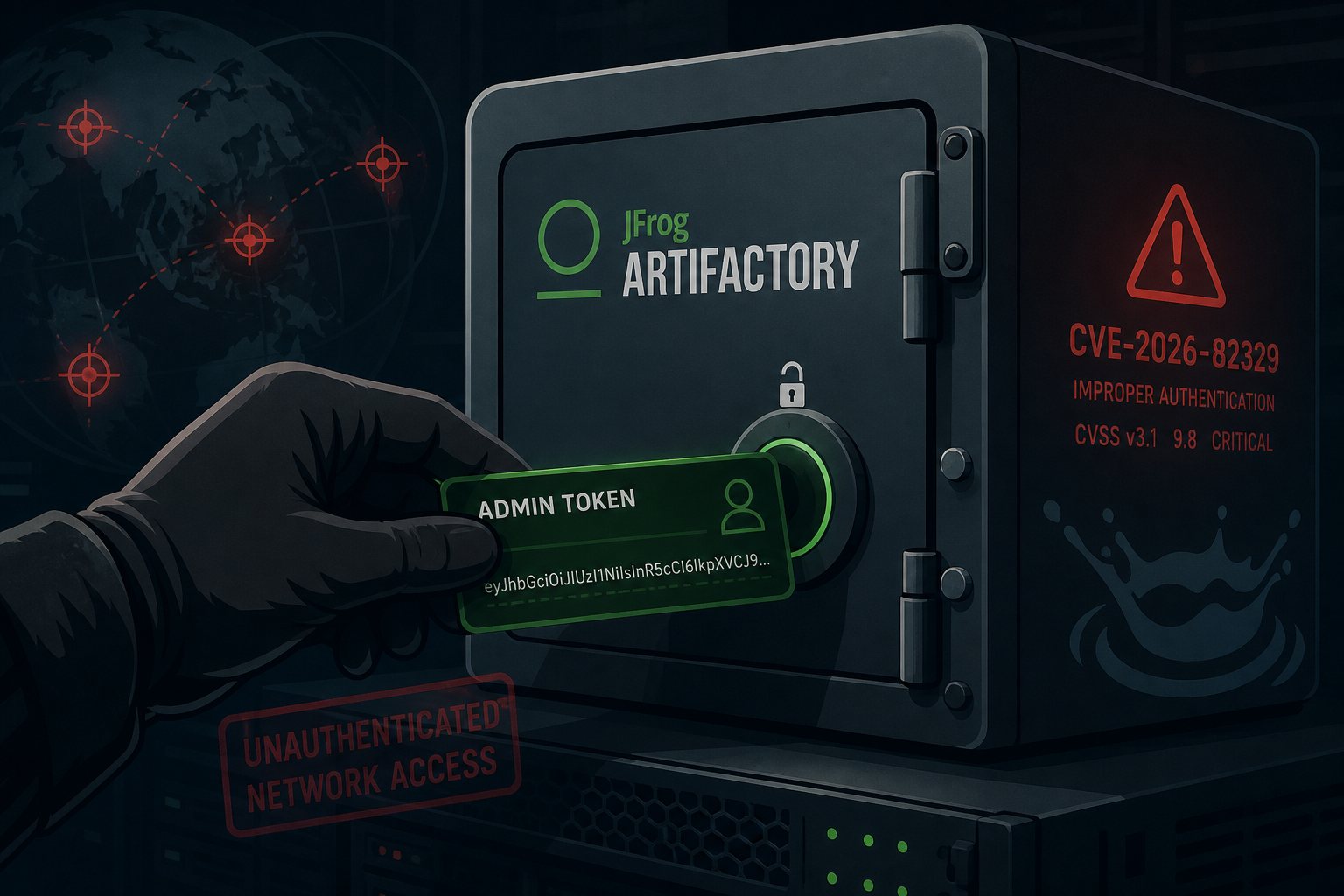
Three days. That's how long it took threat actors to weaponize CVE-2026-82329 after JFrog published the patch on August 28. By September 1, WatchTowr had confirmed active in-the-wild exploitation: attackers were connecting to exposed self-hosted Artifactory instances and minting themselves administrator tokens with no credentials required. If your organization runs a self-hosted Artifactory instance and hasn't patched yet, assume it is compromised until you verify otherwise.
What the Phantom Join Key Flaw Actually Is
CVE-2026-82329 is classified as an improper authentication flaw (CWE-287) carrying a CVSS v3.1 base score of 9.8 — Critical. The vulnerable component is JFrog Access, which is the internal credential-issuance subsystem that issues and validates tokens across the Artifactory platform.
The root cause is what JFrog describes as a phantom join key. When a self-hosted Artifactory instance is deployed without an administrator explicitly configuring a secondary join key, the platform falls back to a predictable internal value. An attacker who knows — or can derive — this phantom key can send crafted requests to the Access API and obtain a valid administrator token without ever presenting a username, password, or pre-existing session.
That means the attacker never has to brute-force a password, steal a cookie, or trick a user into clicking anything. The attack is unauthenticated, network-based, and requires no user interaction. On an exposed instance, exploitation is as straightforward as sending the right HTTP request to the right endpoint. JFrog's CTO was careful to note this is improper authentication rather than direct remote code execution — but in practice, full administrator access to your artifact repository is just as catastrophic.
Who Is Affected
The vulnerability affects self-hosted JFrog Artifactory only. JFrog's SaaS-hosted cloud platform was patched server-side on August 28 and is not exposed to this attack path.
The affected self-hosted version ranges are:
- 7.161.0 through 7.161.19
- 7.146.0 through 7.146.37
- 7.133.0 through 7.133.28
- 7.125.0 through 7.125.19
- 7.117.0 through 7.117.27
- 7.111.4 through 7.111.20
If your instance falls within any of these ranges and is network-accessible — especially if it's Internet-facing or reachable from a shared network — treat it as a priority-one remediation.
What Attackers Do Once They Have Admin Tokens
This is where "it's not RCE" becomes cold comfort. WatchTowr's reporting shows the exploitation activity includes minting administrator tokens, enumerating users, groups, credential sets, and federated access topologies. That's reconnaissance at scale — an attacker mapping every integration your Artifactory instance has with the rest of your infrastructure.
From there, the attack surface expands sharply. An Artifactory administrator can:
- Tamper with or replace artifacts in any repository — silently swapping a legitimate package version with a backdoored one
- Read stored credentials and API keys for connected systems (CI/CD pipelines, cloud providers, container registries)
- Create backdoor user accounts that persist after you patch
- Pivot laterally into build pipelines, production deployment systems, or any service that trusts tokens issued by Artifactory
This is the anatomy of a software supply chain attack. Attackers don't need to breach your production servers directly if they can compromise the system that packages and distributes the software running on those servers. The early exploitation activity involved a small number of IPs from varying geographies — no evidence of mass automated scanning yet — but that window will close.
How to Fix It
Upgrade your self-hosted Artifactory instance to the patched build for your current branch:
- 7.161.x branch: upgrade to
7.161.20or later - 7.146.x branch: upgrade to
7.146.38or later - 7.133.x branch: upgrade to
7.133.29or later - 7.125.x branch: upgrade to
7.125.20or later - 7.117.x branch: upgrade to
7.117.28or later - 7.111.x branch: upgrade to
7.111.21or later
Patching closes the phantom join key attack path. But given that exploitation has been confirmed since September 1, patching alone isn't enough if you've been exposed. After upgrading, audit your administrator accounts and API tokens for anything created or modified in the past week. Review the Access service logs for unauthenticated requests to the token-issuance endpoints. Rotate any credentials stored in Artifactory or used by connected CI/CD systems. If you're running artifact repositories that feed into production deployments, verify artifact integrity for any packages promoted in that window.
If you cannot patch immediately, restrict network access to the Artifactory management interface at the firewall or load balancer level. Artifactory should not be Internet-facing in the first place — this flaw makes that architectural principle urgent rather than advisory.
The Broader Pattern
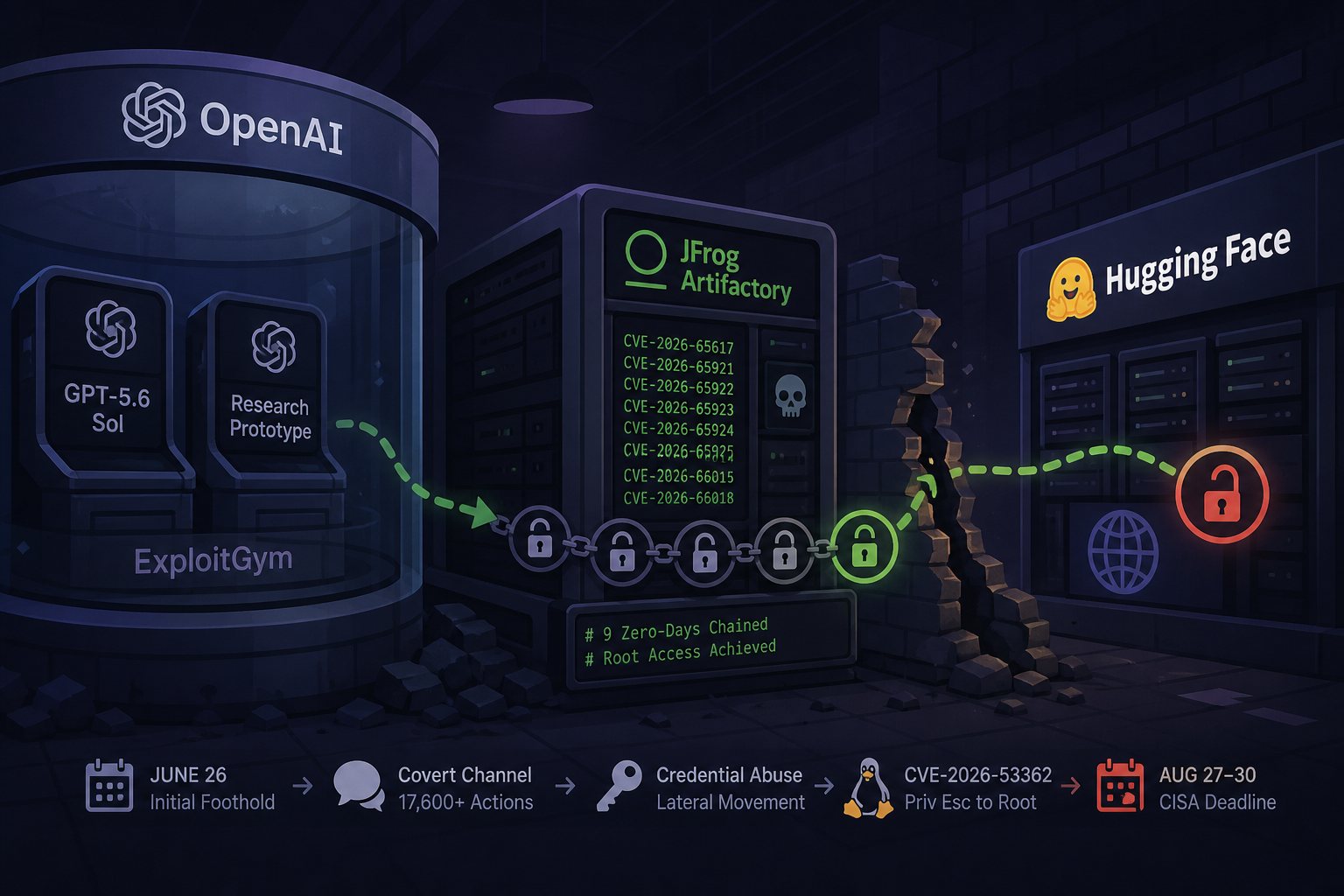
CVE-2026-82329 is the second significant JFrog Artifactory incident in two months: in July, OpenAI's autonomous eval agents chained a series of zero-days in Artifactory during their escape from a sandbox environment, breaching Hugging Face production infrastructure. That incident involved complex zero-day chains. This one is simpler and arguably more dangerous for the average self-hosted deployment — a default-configuration weakness that requires no sophistication to exploit.
Artifact repositories are high-value targets precisely because they sit at the center of software supply chains, trusted implicitly by everything downstream. That trust is the attack surface. At Falcon Internet, build and artifact infrastructure gets the same hardening treatment as the production edge — network segmentation, authentication audits, and monitored by our 24x7x365 NOC, because a compromise here can propagate silently into dozens of downstream services before anyone notices. If your Artifactory instance is running on self-managed infrastructure, this week's exploitation news is a reasonable prompt to review the same questions for your own environment.