GhostLock: 15-Year Linux Kernel Bug Has a 5-Second Public Root Exploit
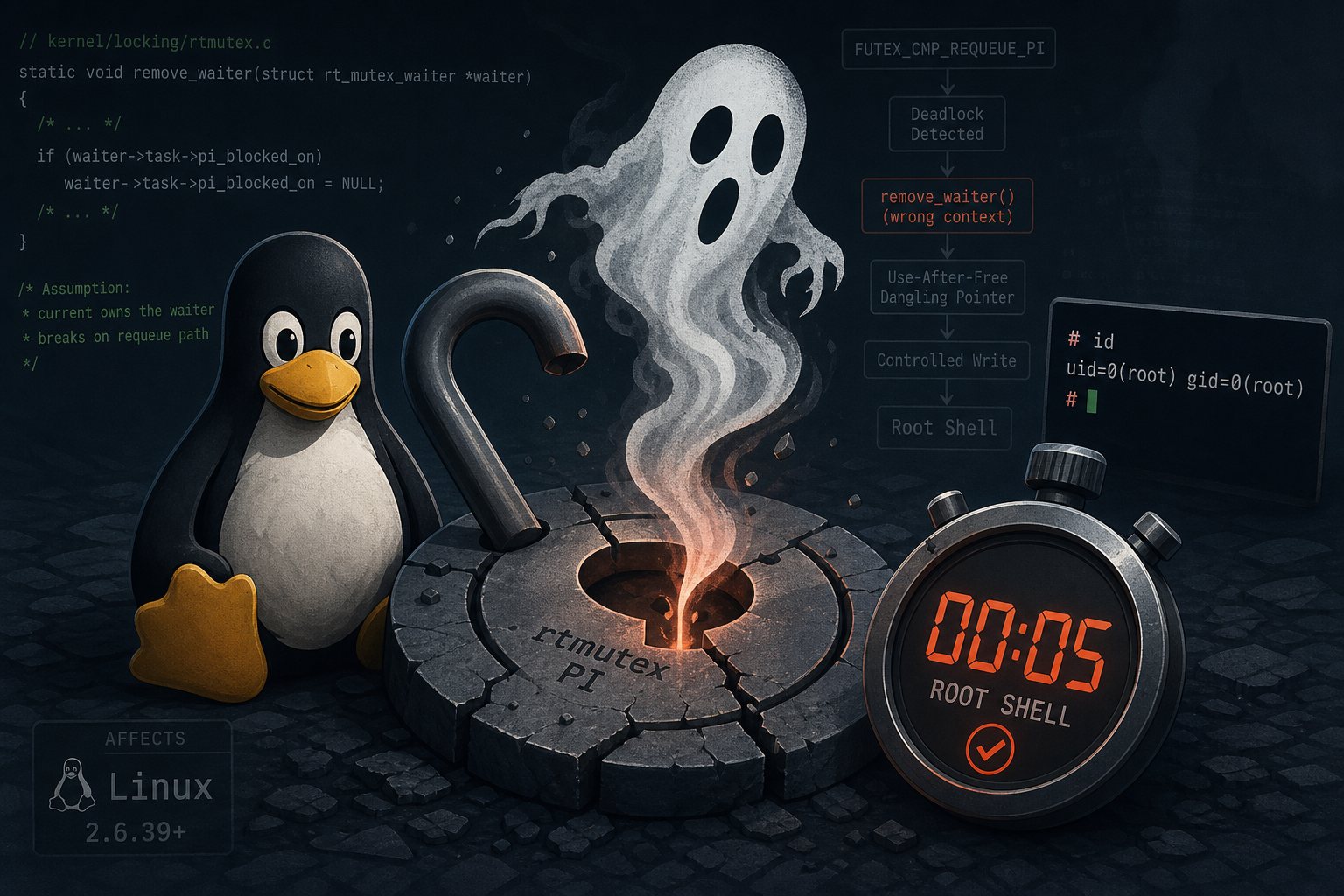
On July 8, 2026, Nebula Security published a working, public proof-of-concept that turns a 15-year-old Linux kernel bug into a root shell in roughly five seconds. The vulnerability, now tracked as CVE-2026-43499 and dubbed GhostLock, sits in the kernel's real-time mutex priority-inheritance code — a subsystem that has shipped in essentially every major Linux distribution since kernel version 2.6.39 landed in May 2011. Google rewarded the find with a $92,337 bug bounty through its kernelCTF program.
Red Hat disclosed a companion CVE, CVE-2026-53166, for a crash introduced by the initial upstream fix, which explains why the patch landscape is still settling. As of publication, several distributions are still working to ship clean fixes.
What Broke and Why
The flaw lives in kernel/locking/rtmutex.c, inside the remove_waiter() helper that unwinds a lock request when an operation needs to be rolled back. The routine was written on the assumption that the thread doing the cleanup always owns the request it is tearing down. That assumption breaks on the FUTEX_CMP_REQUEUE_PI requeue path: when the kernel detects a deadlock cycle during a priority-inheritance requeue, it calls remove_waiter() in a context where the assumption doesn't hold. The result is that the kernel clears pi_blocked_on on the wrong task and leaves a dangling pointer into already-freed kernel stack memory — a classic use-after-free.
Nebula's exploit reclaims that freed region with a carefully shaped allocation, plants a forged kernel structure in it, and then walks the dangling pointer to a controlled write. From there, the path to a root shell is straightforward. In testing, the exploit produced a stable root shell 97% of the time. The other 3% caused a kernel panic — which is loud, but not exactly a deterrent for an attacker with local access.
The only hard requirement is CONFIG_FUTEX_PI, which is enabled by default in every major distribution kernel. There is no privilege, capability, or namespace requirement. An unprivileged shell — the kind any web app process runs as — is enough to trigger it.
Why "Local Only" Isn't Reassuring
Kernel privilege-escalation bugs often get mentally filed under "less urgent" because they require a foothold first. GhostLock deserves more respect than that for a few reasons specific to hosting environments.
On a shared server, local access is the baseline. Every tenant's PHP process, every cron job, every SSH key counts. A single SQL injection or outdated plugin that drops a web shell is enough to hand an attacker a local process — and from there, GhostLock makes root trivial. That root access belongs to the entire host, not just the compromised account. One vulnerable WordPress install on a multi-tenant box becomes a problem for every other site on it.
Container environments aren't sheltered either. The exploit works from inside a container running a standard kernel with full futex access. The IonStack attack chain demonstrated this clearly: researchers chained a Firefox sandbox escape (CVE-2026-10702) with GhostLock to achieve a remote-to-root compromise on Android Firefox, starting from a malicious web page and ending with kernel control. For hosting providers running containerized workloads, the threat model collapses if any container process can trigger this path.
Mitigation: What Actually Helps
The cleanest mitigation is patching the kernel. Where a clean patch is available, that should be the first action. Patched kernel packages for AlmaLinux 8 (kernel-4.18.0-553.141.2.el8_10), AlmaLinux 9 (kernel-5.14.0-687.23.2.el9_8), and AlmaLinux 10 (kernel-6.12.0-211.31.2.el10_2) are available via the AlmaLinux testing repository. Red Hat has confirmed CVE-2026-43499 and CVE-2026-53166 affect RHEL 6 through 10 and all layered products (OpenShift, OpenStack, Virtualization) but noted as of the July 8 disclosure that patches are still in preparation — check the RHSB-2026-010 bulletin for errata as they land.
For environments that need to avoid a reboot, KernelCare livepatch packages covering CVE-2026-43499 are available for CloudLinux 7, 8, 9, and 10 streams — verify with kcarectl --patch-info | grep CVE-2026-43499 after the patch applies.
A seccomp profile that blocks the three futex PI syscall operations — FUTEX_LOCK_PI, FUTEX_WAIT_REQUEUE_PI, and FUTEX_CMP_REQUEUE_PI — closes the trigger path without touching the kernel. The trade-off is real: any application that uses priority-inheritance mutexes will break under that policy. For most web application workloads, this is a viable temporary measure; for real-time or latency-sensitive services, it isn't. Build options RANDOMIZE_KSTACK_OFFSET and STATIC_USERMODE_HELPER raise the exploitation bar but don't fix the underlying bug and shouldn't be treated as mitigations in isolation.
How the Bug Was Found
Nebula Security discovered GhostLock using an AI-driven static analysis tool called VEGA. The finding underscores a pattern that security teams should take seriously: AI-assisted bug-hunting is starting to surface decades-old flaws in code that passed countless human reviews. That the kernel's locking subsystem hid a use-after-free for 15 years isn't an indictment of the people who wrote it — it's a reminder that adversaries now have access to tools that see code in ways auditors historically haven't.
What to Do Right Now
- Check your kernel version:
uname -r. If you're on any mainstream Linux distribution and haven't applied a GhostLock-specific update, assume you're vulnerable. - AlmaLinux users: enable the testing repo and apply the patched kernel; reboot.
- RHEL / CentOS Stream users: monitor RHSB-2026-010 for errata; apply as soon as they're available.
- CloudLinux environments: apply the KernelCare livepatch now; it covers all supported streams without a reboot.
- Containers: add a seccomp rule blocking
FUTEX_LOCK_PI,FUTEX_WAIT_REQUEUE_PI, andFUTEX_CMP_REQUEUE_PIwhile waiting for a kernel patch — this is particularly important for multi-tenant container platforms. - All environments: treat web application compromise as a kernel-privilege event until this is patched. Audit accounts and processes that run with local access to any shared host.
At Falcon Internet, the 24x7x365 NOC monitoring we run on managed servers means kernel-level advisories like this surface in our patch queue the same day they're disclosed — a practice that feels routine until a five-second public root exploit reminds you why it matters.