PHP 8.2.36 to 8.5.13 fix 17 flaws, including PHP-FPM code execution
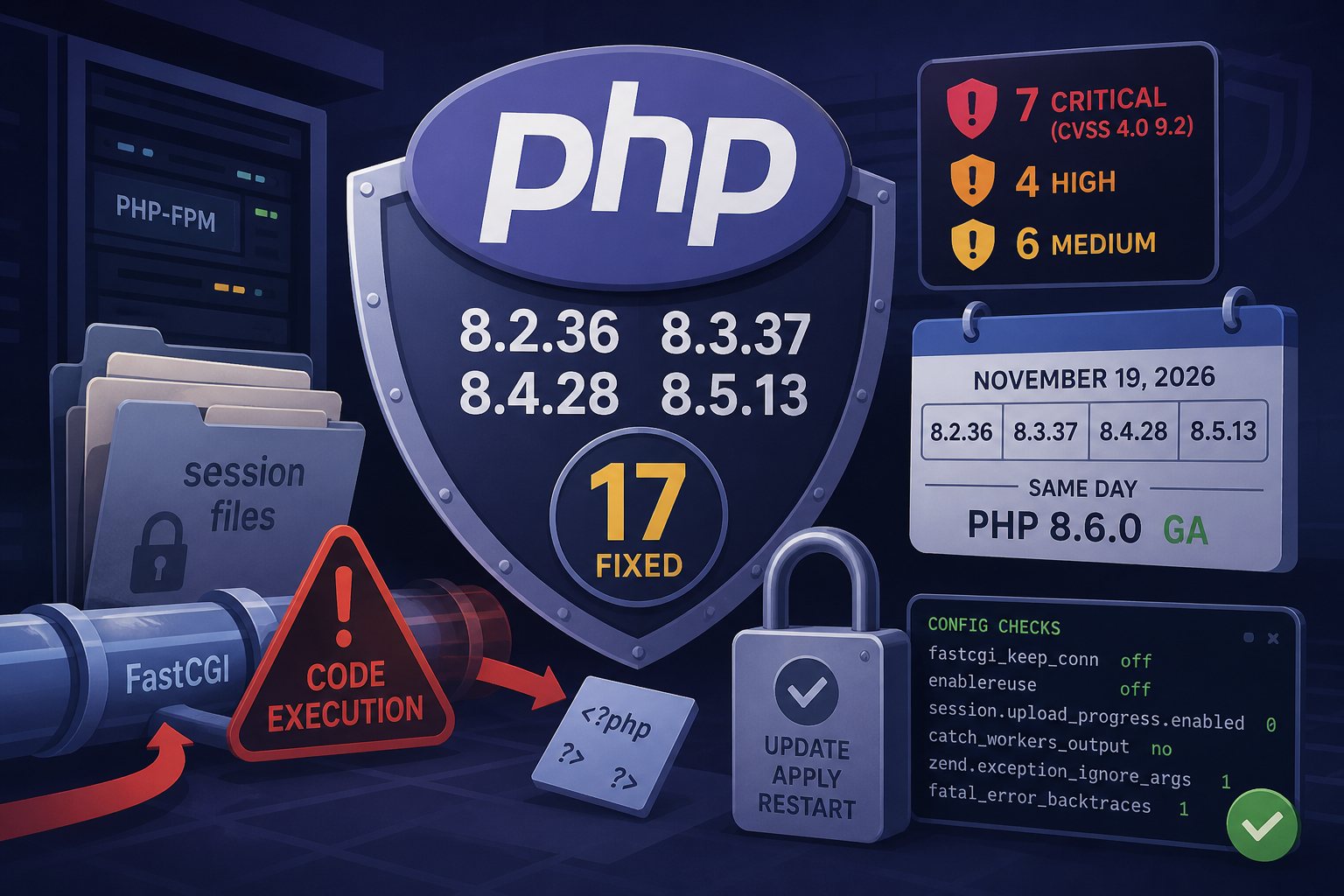
The PHP project released PHP 8.5.13, 8.4.28, 8.3.37 and 8.2.36 on November 19, 2026, the same day PHP 8.6.0 reached general availability. The four branch releases fix 17 vulnerabilities covered by PHP security advisories: 7 rated critical (CVSS 4.0 score 9.2), 4 high and 6 medium. Moving to 8.6 is not required to get the fixes.
This is the second critical PHP release in four weeks. The October 21 releases fixed CVE-2026-109618 and CVE-2026-109619 and do not cover any of this month's bugs, although two of the new critical ones (CVE-2026-129182 and CVE-2026-129481) finish incomplete fixes for CVE-2026-109619. CISA's SSVC data in NVD lists exploitation as "none" for the FPM and session flaws.
Advisories per branch
- PHP 8.5.13: all 17, plus uriparser 1.0.3 for CVE-2026-48841
- PHP 8.4.28: 14
- PHP 8.3.37: 13
- PHP 8.2.36: 12
PHP 8.1 and older get no upstream fixes. The FPM smuggling bug dates to PHP 5.6.0 and the session file bug to PHP 4.1.0, so unsupported builds should be treated as vulnerable.
CVE-2026-129289 runs code through reused FastCGI connections
When an application opened php://input without reading the body to the end, PHP skipped the cleanup that discards unread bytes. A malformed multipart/form-data body can stop PHP's parser at a predictable offset, and the leftover bytes can be shaped into a second FastCGI request. If the web server keeps the backend connection open, PHP-FPM accepts that forged request, which never passed through the front end's routing or access rules.
The forged request sets its own SCRIPT_FILENAME, REMOTE_ADDR and PHP_ADMIN_VALUE. The advisory describes setting allow_url_include=1 and auto_prepend_file=php://input to run attacker PHP as the worker user, with those settings persisting for later requests on that worker. No login, memory corruption or race is needed. Frameworks that open the input stream before routing expose endpoints that never use the body.
Exposure requires backend connection reuse: nginx with fastcgi_keep_conn on, Apache mod_proxy_fcgi with enablereuse=on, HAProxy FastCGI with retained connections, or LSAPI. Stock nginx and Apache configurations close the connection after each request and are not affected by the demonstrated attack. On LSAPI the bug desynchronizes the connection, with no code execution shown.
Two session bugs reach the default files handler
CVE-2026-126714, which its finder depthfirst named phpAfterShell, affects the files session save handler that PHP uses by default. PHP wrote new session data over the old file without truncating it. An interrupted write leaves the start of the new session followed by the tail of the old one, and the next session_start() can deserialize objects the attacker arranged. Code execution also needs a gadget chain in the application. Session upload progress, on by default before this release, gives a remote client one way to place data in the session.
CVE-2026-115560 is a serializer mismatch: upload progress data written with php_binary or php_serialize and read back with php lets part of a session key be parsed as serialized objects. The reporter ran commands through Guzzle and Monolog 2.11.1 gadgets. The mismatch can occur between separate applications, FPM pools or virtual hosts sharing a session directory, and separate pools do not get separate session storage automatically. The fix turns upload progress off by default, but an explicit session.upload_progress.enabled=1 in a config file still wins.
Remaining critical and high-severity fixes
- CVE-2026-129496 (date extension, all branches): a startup warning written to a file-based
error_log, such as one for an invaliddate.timezone, leaves a freed timezone cache that a crafted request can reach in a fresh worker. Clearing startup warnings and restarting PHP removes the demonstrated trigger. - CVE-2026-129474 (8.5 only): requires
fatal_error_backtraces=1, the 8.5 default, withzend.exception_ignore_args=0. The stockphp.ini-productionsetszend.exception_ignore_args=1, which blocks this path. - CVE-2026-129291 (high): code running in an FPM worker can reach root through the FPM master when
catch_workers_outputis enabled. The official PHP-FPM Docker images enable it; the FPM default is off.
Distribution package status on November 20
- Debian 13: php8.4 8.4.28-1~deb13u1 (DSA-6641-1)
- Debian 12: php8.2 8.2.36-1~deb12u1 (DLA-4916-1)
- Ubuntu 26.04: php8.5 8.5.4-0ubuntu1.6
- Ubuntu 24.04: php8.3 8.3.6-0ubuntu0.24.04.14
- Ubuntu 22.04: php8.1 8.1.2-1ubuntu2.29
- RHEL 8, 9 and 10: Red Hat rates CVE-2026-129289 Critical and lists its PHP packages as affected, with no errata yet
Ubuntu's tracker shows the FPM and session file fixes in those builds but still marks CVE-2026-115560 as "Needs evaluation," so set upload progress off explicitly on Ubuntu servers after updating. Containers keep running the old binary until you pull the rebuilt image and redeploy.
Configuration checks and stopgaps
grep -rn "fastcgi_keep_conn" /etc/nginx/
grep -rni "enablereuse" /etc/apache2/ /etc/httpd/ 2>/dev/null
grep -rnE "catch_workers_output|upload_progress" /etc/php/ /etc/php-fpm.d/ 2>/dev/null
php -i | grep -E "upload_progress.enabled|exception_ignore_args|fatal_error_backtraces"
php -i shows the CLI configuration only. FPM pools can override it with php_admin_value lines, so read the pool files too. Until fixed packages are installed:
- Turn off
fastcgi_keep_connor removeenablereuse=on, then reload the web server. - Set
session.upload_progress.enabled=0in php.ini or the pool config. Callingini_set()from the application is too late. - Set
catch_workers_output = noin each FPM pool. - On 8.5, set
zend.exception_ignore_args=1.
After updating, restart PHP-FPM (for example systemctl restart php8.3-fpm), or Apache if it runs mod_php. Existing workers keep running vulnerable code until they are replaced.
PHP 8.2 security support ends December 31
php.net lists the end of PHP 8.2 security support as December 31, 2026, 41 days from today. PHP 8.4 is covered through December 31, 2028. We are moving customer sites off 8.2 to 8.4 now, because each WordPress or Laravel site needs its plugins and themes tested on the new version before the switch.