StyleSmuggler: Magento Zero-Day Under Active Attack — No Patch Yet
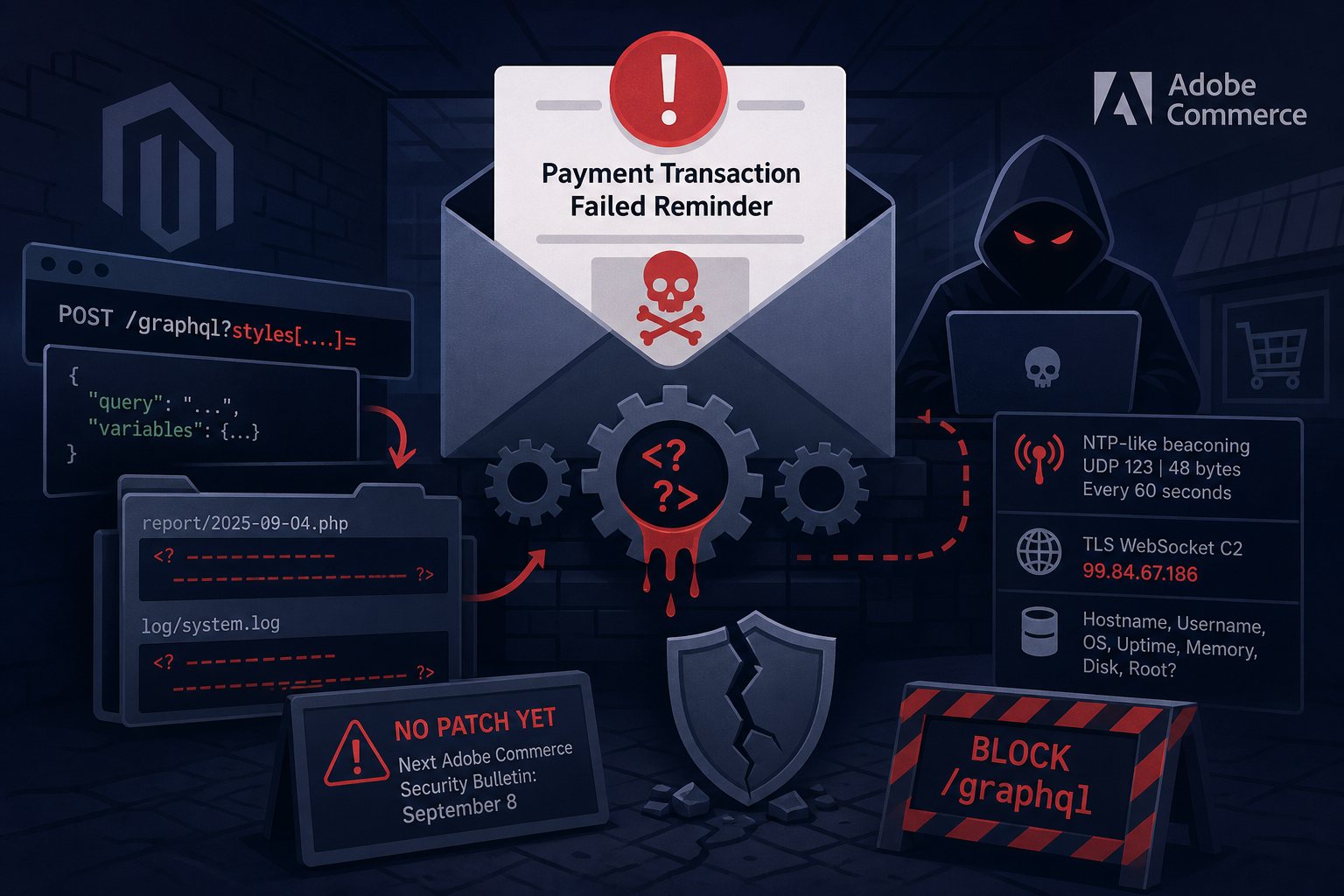
Dutch security firm Sansec found attackers already inside Magento stores on the evening of September 4. They published their findings the next morning before completing the full technical write-up — an unusual move, justified by the fact that compromises were actively happening. The vulnerability is now named StyleSmuggler. As of September 7, Adobe has issued no security advisory, assigned no CVE identifier, and shipped no fix. The only official patch window on the horizon is tomorrow: Adobe's next scheduled Commerce security bulletin drops September 8, and whether it covers StyleSmuggler is still unknown.
Who Is Exposed — and Why Being Fully Patched Doesn't Help
Magento Open Source and Adobe Commerce versions 2.4.7, 2.4.8, and 2.4.9 are all confirmed vulnerable. Sansec's first identified victim was running 2.4.6-p15 — the latest patch level for that branch, with both the July and August 2026 security updates applied. Every update installed. Still compromised.
That's the uncomfortable math here: upward of 111,000 Magento and Adobe Commerce installations are exposed with no vendor fix available. If you run Magento or Adobe Commerce for an e-commerce store, you are in this pool regardless of your patch history. Patch diligence is a good habit; it just doesn't help when the vulnerability exists in fully-patched code.
How the Attack Actually Works
StyleSmuggler unfolds in two stages, neither of which requires any kind of account or credential on your store.
Stage one — poisoning: The attacker sends a crafted POST request to Magento's GraphQL endpoint: POST /graphql?styles[....]=. The styles query parameter feeds into Magento's template processing system, and there's a gap in the sanitization there. The attacker uses it to plant malicious PHP into files Magento writes itself during normal operation — specifically into report files and log entries under var/report or var/log/system.log. No suspicious file upload, no unusual path traversal. Just Magento writing its own logs with attacker-controlled content inside.
Stage two — detonation: Here is the part that's almost elegant in a grim way. The attacker deliberately triggers Magento's built-in Payment Transaction Failed Reminder email. When Magento renders that email server-side, a crafted directive in the poisoned log file forces Magento's own class-loading machinery to pull in and execute the planted PHP. Nobody clicks anything. Nobody opens any email. The store's own mail-rendering process does the work, and the attacker's code runs with the web server's privileges.
Watch for unusual bursts of payment failure email notifications — but don't assume silence means safety. The attack succeeds even when email delivery fails, because the execution happens during rendering, not delivery.
What Attackers Leave Behind
Once inside, attackers are deploying a Rust-based backdoor that impersonates legitimate system processes to avoid detection. Current variants have been spotted masquerading as fc-cache and chronyd — process names that won't raise flags on casual inspection. The implant beacons every 60 seconds over what appears to be NTP traffic (UDP port 123, 48-byte packets) and maintains a TLS WebSocket channel back to its command-and-control server at 99.84.67.186. It sends home: hostname, username, OS version, memory and disk usage, uptime, and whether it's running as root.
Persistence is via cron. A second attacker, apparently running a different campaign on the same vulnerability, is dropping PHP webshells into pub/media/catalog/product/cache/ — the directory that stores resized product images and is often world-readable. Known malicious domains in this campaign include 247.cdnflare.xyz (note: not the legitimate Cloudflare domain) and C2 endpoints at 185.157.160.251 and windwsecurity.run.
Mitigation Steps — Right Now, Before a Patch Exists
With no vendor fix available, mitigation is operational rather than surgical. Here's the priority order:
- Disable GraphQL at the web server or load balancer level. Block
POST /graphqlrequests entirely until Adobe ships a fix. Many Magento storefronts running older themes don't depend on GraphQL for customer-facing functionality — but verify yours before pulling the switch. PWA storefronts and headless setups will likely need it, and those operators should prioritize WAF rule deployment instead. - Scan for active compromise:
- Check for PHP files where they shouldn't be:
find pub/media -name '*.php' - Review running processes for
fc-cacheorchronydinstances in unexpected paths like/tmpor~/.cache - Look at
www-data's crontab for unauthorized entries - Search system logs for:
crontab: (www-data) AUTH (crontab command not allowed)— this appears when the backdoor tries to install its cron persistence
- Check for PHP files where they shouldn't be:
- Block known C2 infrastructure at your firewall:
99.84.67.186,185.157.160.251,247.cdnflare.xyz, andwindwsecurity.run. These are active as of September 7. - Rotate all credentials — Magento admin, database, and any API keys in
env.php— if you find any evidence of compromise. The backdoor's reconnaissance payload includes credential paths, and anything on a compromised server should be treated as exfiltrated. - Deploy or update WAF rules. Sansec's Shield product was updated September 5 to block the GraphQL injection vector. Generic ModSecurity rule sets and other WAF vendors are rolling out coverage — check your vendor's threat feed now if you haven't already.
Why This One Stings
StyleSmuggler works by turning Magento's own trusted machinery against itself. The log writer is the file dropper. The email renderer is the code executor. An intrusion detection system watching for classic indicators — suspicious file uploads, unusual outbound connections during normal hours, modified PHP files in document root — will likely miss stages one and two entirely. The alert that tips you off is either a process name in a strange path or an unexpected cron entry under www-data.
This is a recurring theme in e-commerce attacks: the most effective ones abuse functionality the platform was designed to have. MageCart attacks rode Magento's JavaScript asset pipeline. This one rides its email template renderer. The platform's own feature set is the attack surface.
It's also a reminder that monitoring depth matters as much as patch cadence. At Falcon Internet, 24x7x365 NOC monitoring covers hosted environments at the process and filesystem layer — not just the perimeter — precisely because a zero-day on fully-patched software needs eyes on what the server is actually doing, not just what software version it's running.
Adobe's bulletin drops September 8. Monitor the official Adobe Commerce security advisory channel and assume StyleSmuggler is not covered until the advisory explicitly says so. Sansec's research page at sansec.io/research/stylesmuggler has the most current IOCs and compromise-detection commands as the situation evolves.