Claude Fable 5.1: 75% Cheaper Cache, EU Watermarks, and a New Line on Security Work
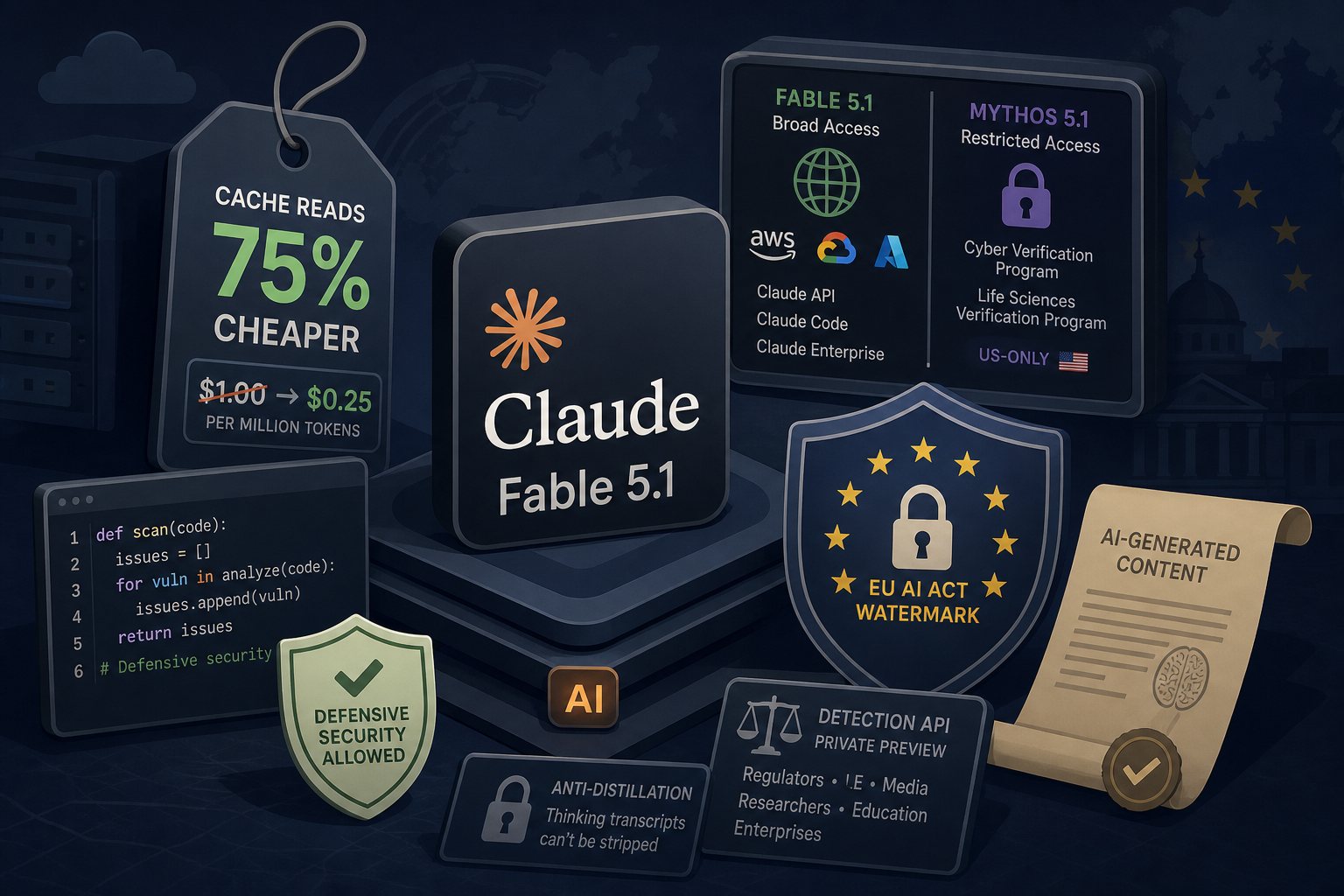
Anthropic shipped Claude Fable 5.1 and Claude Mythos 5.1 on September 1, 2026, and buried the most interesting changes underneath a headline that reads like a pricing update. Yes, cache reads are 75% cheaper now. But the more durable shifts are about what the model is now allowed to do — and what it will leave a permanent, invisible mark on.
One Model, Two Permission Sets
Fable 5.1 and Mythos 5.1 are not separate architectures. They run the same underlying model with different safeguard thresholds. Fable 5.1 is broadly available through the Claude API, Claude Code, Claude Enterprise, and every major cloud platform (AWS, Google Cloud, Azure). Mythos 5.1 sits behind Anthropic's new Cyber Verification Program and Life Sciences Verification Program — access restricted to vetted organizations doing defensive security work or professional biomedical research.
The programs are US-only for now, which has already drawn criticism from European cybersecurity firms who are caught inside the EU AI Act's compliance requirements but locked out of the model tier that helps with compliance work. Anthropic says international expansion is coming; they haven't said when.
The Cost Math
Cache-read tokens dropped from $1.00 to $0.25 per million — a genuine 75% cut. Standard input and output pricing holds at $10 and $50 per million tokens respectively, so this matters most to teams whose workloads lean on prompt caching: long system prompts reused across many calls, retrieval-augmented generation pipelines, or agentic loops that repeatedly reference the same documents.
Anthropic's own estimate: roughly 25% total cost reduction for typical workloads, up to 45% for highly agentic pipelines. If you're building anything that looks like an AI agent — a customer support bot that reads a large knowledge base, an internal assistant that carries company context across sessions — the savings can be real. For pure one-shot completions, the change is marginal.
What the Benchmarks Actually Say
The headline benchmark is Terminal-Bench-Science 0.1: Fable 5.1 hits 52.6% versus Fable 5's 24.7% — more than double. That's an unusually large generational jump for a point release, and it's where the scientific capabilities Anthropic is promoting (protein binder design, deep learning optimization, high-resolution topographic modeling) are grounded. For general coding, CursorBench 3.2.0 lands at 73.4%, and the long-horizon computer-use benchmark OSWorld 2.0 (strict grading) hits 41.7%.
Compared to OpenAI's GPT-5.6 Sol, Fable 5.1 wins on SWE-Bench Pro — 80% versus Sol's 64.6% — which uses real repositories and real bugs rather than synthetic puzzles. Sol still leads on the Coding Agent Index and on raw token efficiency and cost. The practical read: for deep, multi-file, hard-to-specify engineering problems, Fable 5.1 has an edge; for high-throughput, cost-sensitive workloads, Sol is still cheaper to run.
The Security Shift — What Changed and Why
This is the part that affects anyone using AI tooling in a development or operations context. In previous model generations, Claude's safeguards would sometimes fire on benign security-related developer queries — asking about common vulnerability patterns, reading CVE write-ups, or writing security-testing code. Anthropic reports 60% fewer such interventions in Fable 5.1, with an 85% reduction for benign biology queries in Mythos 5.1.
More meaningfully, Fable 5.1 is now explicitly permitted to help identify software vulnerabilities for defensive purposes. It will scan code, reason about attack surfaces, and flag potential flaws. What it won't do: generate working exploits, conduct penetration tests, or perform binary-level scanning. The distinction matters — the previous posture sometimes made the model less useful than a search engine for developers trying to do the right thing. The new posture draws the line at offense rather than at the entire topic.
Anthropic had two external organizations plus Gray Swan AI conduct adversarial stress-testing before release. No critical-severity jailbreaks were found.
EU AI Act Watermarking: What It Means for Your Content
Every output from models released after August 2, 2026 — Fable 5.1 included — carries an invisible numerical watermark required by the EU AI Act's AI-generated content transparency provisions. The watermark contains no user data and has no visible effect on output quality. Anthropic describes it as a statistical signal, not steganographic encoding, that allows a detection API to assess the probability that a given piece of text was generated by Claude.
That detection API is now in private preview, available to regulators, law enforcement, media organizations, fact-checkers, independent researchers, educational institutions, and enterprises that have their own legal obligations under the Act.
For businesses publishing AI-assisted content — blog posts, product descriptions, help documentation — the practical effect right now is minimal. The watermark doesn't show, and detection access is tightly controlled. What it does signal is the direction: AI-generated content is going to become identifiable infrastructure-wide, not just by policy statements on a footer. Businesses that are already labeling AI-assisted content honestly are ahead of the curve; those treating that disclosure as optional should reconsider their timeline.
One Breaking Change Worth Knowing
New API accounts can no longer manually edit prior context in a way that strips Claude's thinking transcripts — a technique some teams used to distill the model's reasoning into cheaper pipelines. Existing accounts are in a transition window, but the capability is going away. Anthropic frames this as an anti-distillation control to protect model IP; teams that relied on the pattern will need to rework their pipelines.
Practical Guidance for Small and Mid-Size Businesses
If you're already using Claude via the API or Claude Code for development work, the cache-read pricing cut is a straight-up win — update your billing projections and reassess what was previously too expensive to cache. If you're evaluating AI assistance for your development team, Fable 5.1's improved tolerance for security-related queries makes it meaningfully more useful for the day-to-day reality of web development: auditing dependencies, reading security advisories, writing hardened input validation.
If you're generating customer-facing content with AI, think now about how you'll handle watermark discoverability as detection becomes more accessible. The tools don't exist yet for most businesses to check their own output, but they're coming — and the question of labeling is better answered before it's asked of you by a customer or regulator.
At Falcon Internet, we've been watching the intersection of AI tooling and web infrastructure since large models became practical engineering tools. What we notice about Fable 5.1 is how deliberately Anthropic is threading the needle between expanding capability and drawing explicit lines around the most dangerous uses. That's not just a safety story — it's an architecture decision that shapes what the model is actually useful for. The 75% cache discount will show up on invoices this month. The rest of it will take longer to land.