Gemini 3.7 Flash: Google's Biggest Coding Leap Yet, at Half the Price
On August 13, 2026, Google released Gemini 3.7 Flash — just three weeks after Gemini 3.6 Flash — and the timing tells its own story. Google's flagship Pro model has now missed its original June ship date by more than two months, with reports of persistent coding benchmark failures, hallucinations, and senior-researcher churn. So Google is doing what any good engineering org does when the flagship slips: it keeps shipping what works. Flash is carrying the weight right now, and based on yesterday's numbers, it is pulling that weight impressively.
The Benchmark Jump Is Real
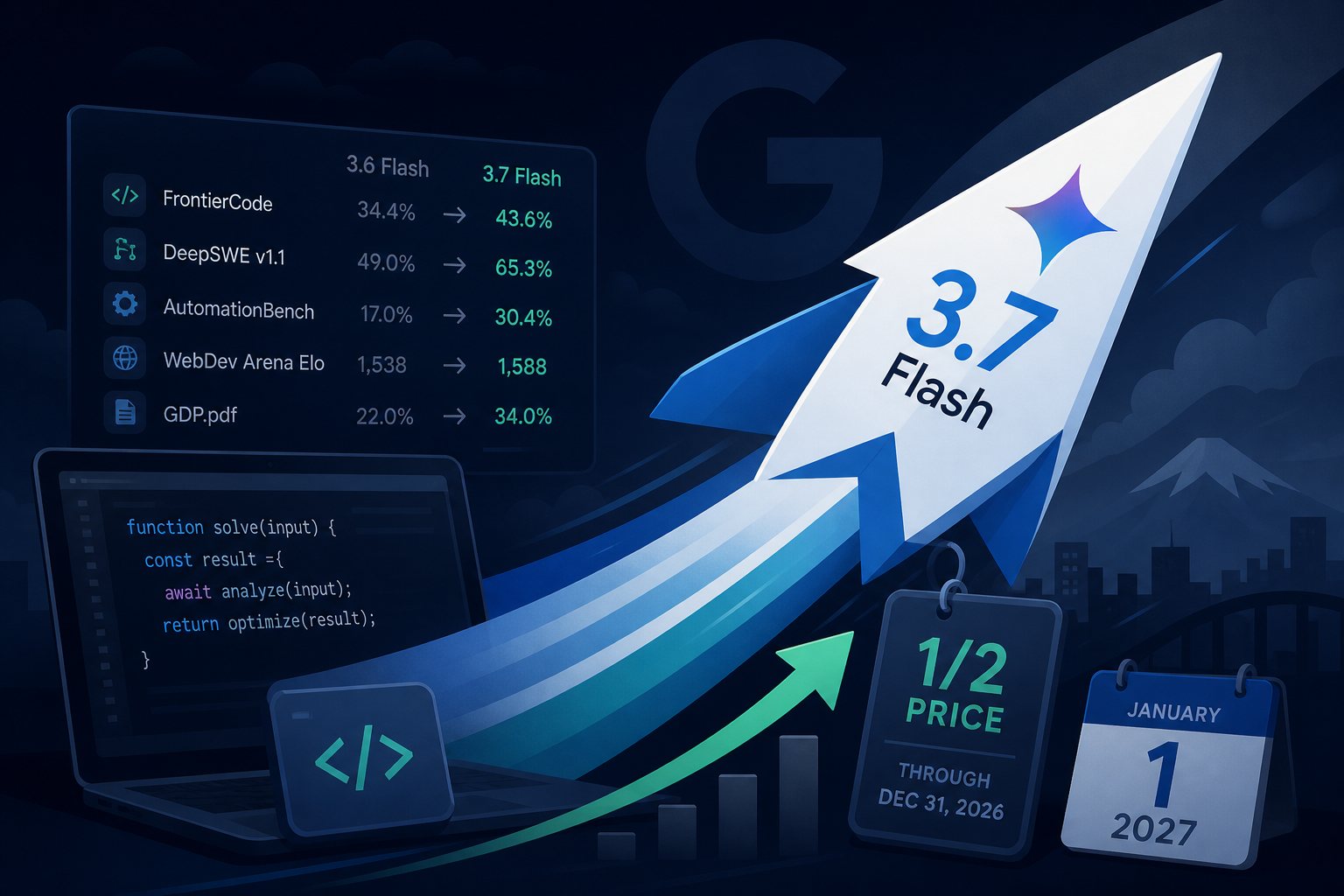
Google's own performance table shows gains across every major evaluation category compared to 3.6 Flash, which itself was only three weeks old:
- FrontierCode 1.1 (Cognition's coding benchmark): 43.6%, up from 34.4%
- DeepSWE v1.1 (long-horizon software engineering, by Datacurve): 65.3%, up from 49.0%
- AutomationBench (enterprise workflow automation): 30.4%, up from 17.0%
- WebDev Arena Elo (head-to-head web dev quality, Arena.ai): 1,588, up from 1,538
- GDP.pdf (knowledge-dense document comprehension): 34.0%, up from 22.0%
A 16-point swing on DeepSWE and a near-doubling on AutomationBench in three weeks is a serious jump, not incremental polish. Google attributes it to algorithmic improvements rather than raw compute scaling — which, if accurate, means diminishing cost as capability rises.
On the competitive scorecard — using Google's own benchmark table, which warrants appropriate skepticism for competitor comparisons — 3.7 Flash at 43.6% on FrontierCode edges Claude Sonnet 5 (42.7%) and GPT-5.6 Terra (41.3%). On DeepSWE, OpenAI's Terra still leads at 69.6%, but 3.7 Flash closes the gap. On AutomationBench, 3.7 Flash at 30.4% substantially outpaces Terra at 23.6% and Sonnet 5 at 10.7%. Multiple outlets covering the release treat the coding gains as credible, pending independent replication.
Flash Is the Flagship Now (Like It or Not)
The Pro model situation is worth understanding because it shapes how to think about Gemini's roadmap. Gemini 3.5 Pro was internally positioned as Google's answer to the frontier — the model that would meaningfully close the gap on the hardest reasoning and coding tasks. It was originally targeted for June. It is now mid-August, and Bloomberg's coverage of yesterday's Flash release makes the subtext explicit: Google debuting a new Flash model while its top AI remains delayed.
The reported issues — coding benchmark underperformance, inconsistent outputs, hallucinations at the hard end — are exactly the categories where 3.7 Flash is now making its biggest gains. Whether Pro is on a different architectural track or whether the Flash iteration is effectively absorbing the Pro roadmap is not yet clear. What is clear: the Flash line is where Google's deployable progress is happening, and 3.7 Flash is the most capable Gemini model you can actually use in production today.
That is a meaningful shift. A year ago, Flash connoted fast and cheap but not the best. In 2026, Flash is Google's most capable deployed model. Businesses that deferred Gemini integration waiting for a more powerful Pro release should reconsider that calculus.
The Pricing Window Closes January 1
Gemini 3.7 Flash launches at half the price of Gemini 3.6 Flash at its own launch: $0.75 per million input tokens and $3.75 per million output tokens through December 31, 2026. On January 1, 2027, the model reverts to its permanent pricing: $1.50 per million input tokens and $7.50 per million output tokens.
At the introductory rate, 3.7 Flash is roughly three-to-four times cheaper than Claude Sonnet 5 ($2/$10) and GPT-5.6 Terra ($2/$12) per million tokens, while matching or beating them on several coding benchmarks. That is an unusually strong value proposition — and it has an explicit expiration date. Organizations evaluating AI tooling for coding pipelines, document workflows, or agent automation have a roughly 4.5-month window to lock in usage patterns at those rates.
The model is available now via the Gemini API in Google AI Studio, Antigravity, and Android Studio. In the Gemini consumer app, it is rolling out to the Spark tier, which requires an AI Pro or Ultra subscription.
What This Means for Small and Mid-Size Businesses
For a business running a website, an e-commerce store, or any workflow that involves repetitive text generation, document review, or light software development, the practical implications break down this way:
- Coding assistance is the headline use case. If your team uses AI to write, review, or debug code — for your CMS, your internal tools, your custom integrations — the DeepSWE and FrontierCode gains are directly relevant. The model is meaningfully better at sustained, multi-step engineering tasks than its predecessor.
- Web development quality improved measurably. The WebDev Arena Elo gain (1538 to 1588) reflects better-quality layout generation and more feature-complete app scaffolding in fewer iterations. For teams prototyping or extending web apps with AI assistance, this matters.
- Agent workflows got the largest single-cycle improvement. AutomationBench nearly doubled (17.0% to 30.4%). If you are building or buying AI-powered automation — customer email handling, document routing, content pipelines — 3.7 Flash is worth re-evaluating even if you tested 3.6 Flash and found it marginal.
- Plan for the price change. If you are building anything cost-sensitive on Gemini's API, architect it now knowing that input costs double on January 1. Budget accordingly or validate your usage against the permanent tier before committing.
At Falcon Internet, we watch this landscape because the models our clients' developers reach for — for content generation, CMS automation, and custom code — directly affect how those applications are built and hosted. A capable, cheap model that actually ships beats a theoretically superior one that keeps missing its release date. Gemini 3.7 Flash shipped yesterday. That counts for something.