vCenter CVE-2026-123890 exploited since September; fix is 8.0 U3m
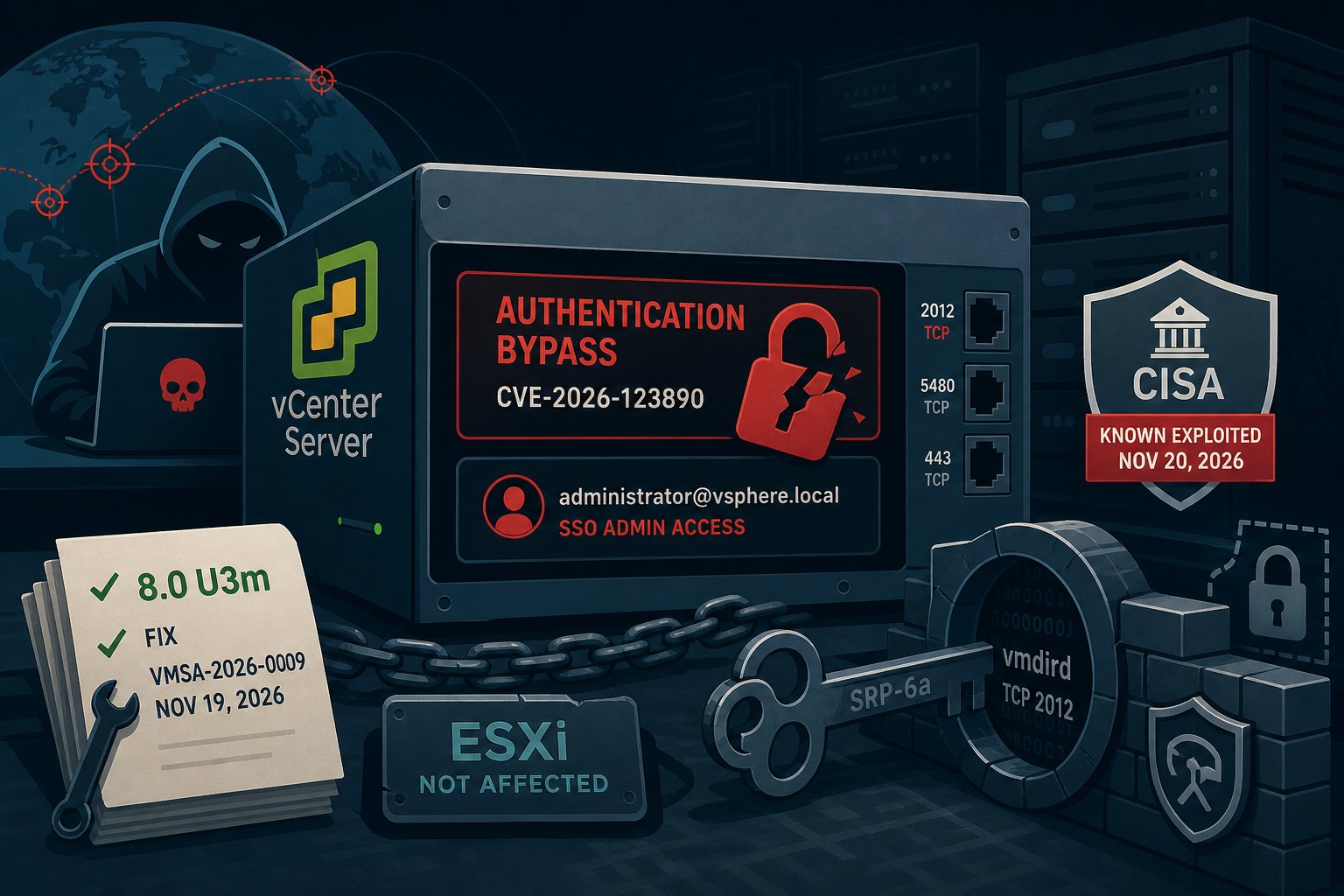
Broadcom published VMSA-2026-0009 on November 19, 2026. Its lead issue, CVE-2026-123890, is an authentication bypass in the VMware Directory Service on vCenter Server, rated CVSS 9.8 (CWE-288). An unauthenticated attacker who can reach the appliance over the network gets a session as administrator@vsphere.local. Mandiant reported it, and Google Threat Intelligence Group (GTIG) says a suspected PRC-nexus espionage group it tracks as ARMORY CASTLE (formerly UNC5221) was using it as a zero-day in early September. CISA added it to the Known Exploited Vulnerabilities catalog on November 20 with a federal due date of November 23 and flagged it for forensic triage, so agencies must check for prior compromise as well as patch.
Small and mid-size companies running a three- or four-host vSphere cluster, often looked after by one administrator or a contractor, are the most likely to have an unpatched vCenter on a flat network.
Fixed vCenter builds by branch
- vCenter 9.1.x, including VCF and vSphere Foundation 9.1: 9.1.1.0200
- vCenter 9.0.x: 9.0.2.0200
- vCenter 8.0: 8.0 U3m
- VCF 5.x: vCenter 8.0 U3m through async patching (KB 88287), with SDDC Manager 5.2.5
- vCenter 7.0: no public build. vSphere 7 reached end of general support on October 2, 2025, and Broadcom tells extended-support customers to request the fix through a support case.
Broadcom lists no workaround. The updates are not eligible for vCenter Quick Patch, so they go through the appliance management interface (VAMI) on port 5480. Running VMs stay up during the update, and ESXi is not affected by this CVE.
The advisory FAQ covers two version traps. First, this is a separate bug from CVE-2026-59309, the 9.8-rated directory service bypass patched in July under VMSA-2026-0006, and GTIG says the exploit tool worked against a vCenter that already had the July fix. Second, 8.0 U3m and 9.0.2.0200 cannot currently upgrade to VCF 9.1.1. If a 9.1 upgrade is already on the calendar, go straight to 9.1.1.0200; otherwise patch the branch you are on and wait for 9.1.2 before moving.
How the SRP session key leak works
GTIG describes the flaw as an SRP-6a session key disclosure over DCE/RPC in vmdird, the directory service behind vCenter Single Sign-On. The SRP authentication interface builds identifiers from predictable UUIDv1 timestamps, which lets an attacker recover a session key and authenticate as the SSO administrator. The service listens on TCP port 2012, the SSO control RPC interface. The July bug went through LDAP on 389 and 636, so firewall rules written in response to that advisory may leave 2012 open.
Post-exploitation steps in the GTIG report
In the intrusion GTIG documented, the attackers first compromised a BeyondTrust Remote Support appliance through CVE-2026-102764, which the same group had exploited as a zero-day, then moved to an internal Linux appliance with no endpoint agent and escalated to root. From there:
- A Go tool GTIG calls BONESAW copied the directory database (
/storage/db/vmware-vmdir/data.mdb), extracted the STS SAML signing key, created a backdoor machine account and an SSO admin account, and assigned itself Global Administrator on the vCenter root folder. - A second tool, SAWSNAKE, used the stolen key to forge SAML assertions for any user. Forged tokens skip MFA entirely.
- The attackers enabled SSH on vCenter through the VAMI API (
PUT /rest/appliance/access/ssh), copied the vCenter master key and the PostgreSQL password file, and turned SSH back off. - Using the
vpxuseraccount, they logged into ESXi hosts, added an SSH key for root, and read guest disks straight off VMFS to pullNTDSand registry hives from domain controller VMs.
Copying NTDS from a virtual disk yields every domain password hash without running anything inside the domain controller, so Windows security software on that server has nothing to see. Patching vCenter afterward does not undo any of it.
Checks for signs of compromise
- In the vSphere Client, open Administration > Single Sign On > Users and Groups and account for every user in
vsphere.local. GTIG saw an attacker account following the patternsps-...@vsphere.local. - Review VAMI and appliance logs for SSH being enabled and disabled again within a short window.
- On vCenter and on Linux appliances that can reach it, look for
/tmp/123,/tmp/sss,/tmp/dbr,/tmp/123.key,/tmp/123.rar,/usr/bin/vmtoolscs, and webshells namedActiveSer.jsporu.jsp. - On each ESXi host, check
/etc/ssh/keys-root/authorized_keysfor keys nobody on your team added. - Scan internal ranges for the BEARBONES SSH banner
SSH-2.0-pulsesecure_23345. Include firewalls and routers, where GTIG found it on high ports.
nmap -p- -sV --script banner --open 192.168.10.0/24 | grep -i -B6 pulsesecureIf any of these turn up, assume the attackers hold the SAML signing key. Replace the STS signing certificate, reset all SSO and local appliance passwords, and if domain controllers ran on the cluster, reset the krbtgt account twice and every privileged domain password.
Locking down port 2012 and the management network
vCenter should never face the internet, and in the documented case the attacker came from inside, by way of a remote support box. Restrict ports 2012, 443 and 5480 on vCenter to a jump host or a short list of admin workstations. Mandiant's vcsa-hardening-tool on GitHub applies iptables rules and remote syslog to the appliance. The VAMI firewall does not log denied connections, so forward appliance logs to a syslog server you control. Linux appliances that sit next to vCenter should get an EDR agent or, at minimum, log forwarding. We keep hypervisor management interfaces on a separate network reachable only from a VPN-connected jump host for the same reason.
vCenter 7.0 without extended support will not get a fix. Block port 2012 from everything but the jump host and schedule the move to 8.0 U3m or 9.x.