WordPress.org hold stops backdoored updates to six WP connect plugins
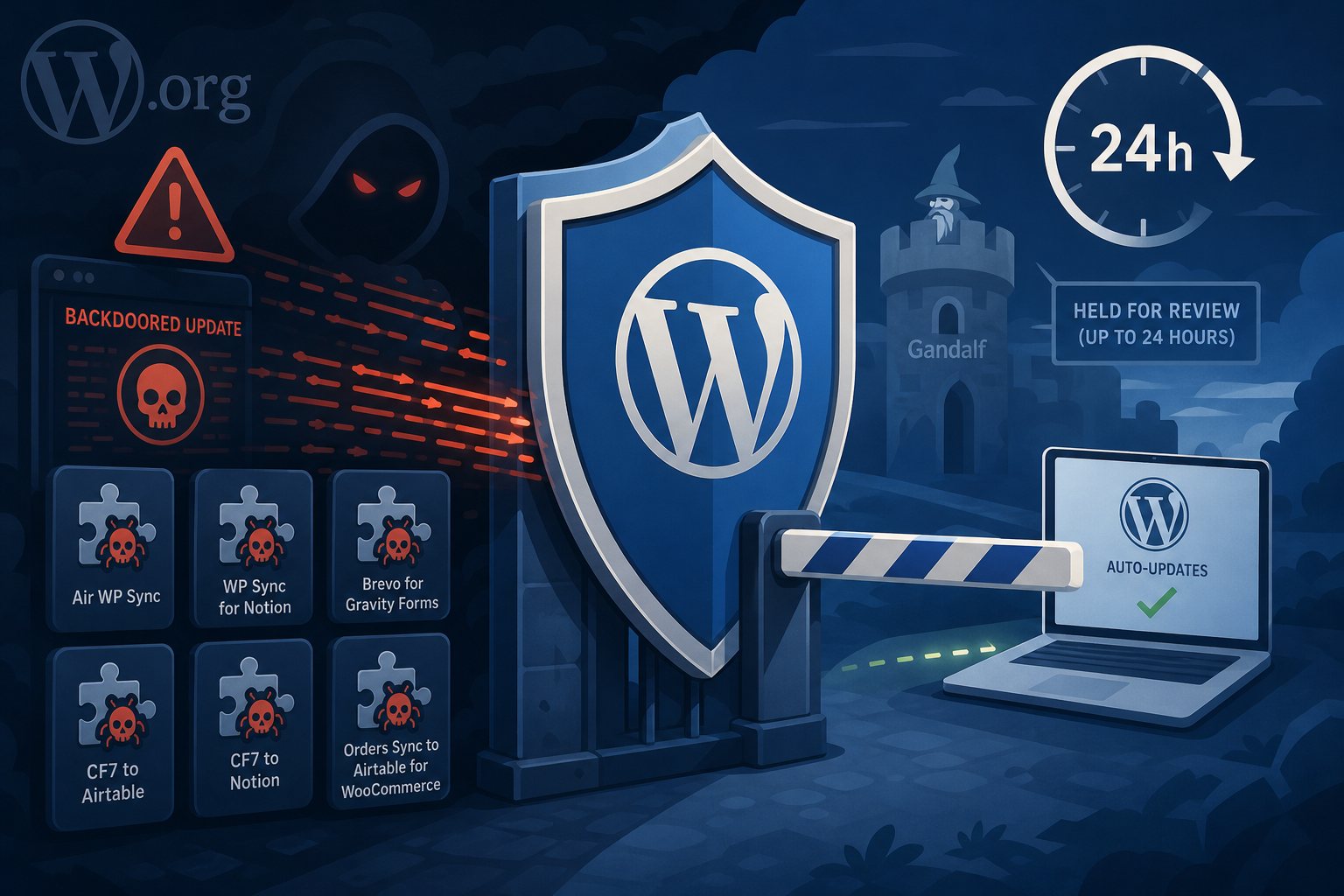
On the afternoon of November 22, 2026, someone used the WordPress.org account of plugin developer WP connect to push backdoored releases of six plugins. The plugins have more than 3,600 active installs combined, according to Wordfence. WordPress.org closed all six the same day, and Wordfence says none of the nine malicious releases reached sites, because WordPress.org now holds new plugin releases before sending them out as auto-updates. Wordfence, acting as the CNA, assigned CVE-2026-135202 (CVSS 3.1 score 9.8, CWE-506 embedded malicious code). NVD published the record on November 24.
Timeline of the November 22 compromise
Wordfence puts the malicious commits between roughly 4:30 PM and 5:40 PM US Eastern. Air WP Sync received four releases in about 30 minutes, 2.9.1 through 2.9.4, and the other five plugins got one release each within minutes of one another. Wordfence's automated scanner flagged WP Sync for Notion 1.7.4 and Air WP Sync 2.9.4 within a minute of each other that evening. The WordPress.org plugin API now reports all six as "closed as of November 22, 2026," and states the closure is permanent.
WP connect has said its account was compromised. As of November 24 neither WP connect nor Wordfence has said how the account was taken.
Six plugins and nine backdoored versions
- Air WP Sync (air-wp-sync): 2.9.1, 2.9.2, 2.9.3, 2.9.4
- WP Sync for Notion (wp-sync-for-notion): 1.7.4
- Add-on Brevo for Gravity Forms (addon-gravityforms-sendinblue-free): 2.6.3
- Add-On for Contact Form 7 to Airtable (add-on-cf7-for-airtable): 2.5.4
- Add-On for Contact Form 7 to Notion (add-on-cf7-for-notion): 1.6.4
- Orders Sync to Airtable for WooCommerce (orders-sync-to-airtable-for-woocommerce): 1.0.2
Wordfence says the release before each of these is clean. We checked the Air WP Sync tags in the plugin's public Subversion repository: 2.9.0 has no includes/airwp-online.php, and 2.9.4 loads it with a single require_once line in the main plugin file. Air WP Sync 2.9.1 carries an earlier draft of the module. The other five plugins ship an identical copy.
Behavior of includes/airwp-online.php
We read the 563-line file from the 2.9.4 tag, which is still readable in SVN. It hooks init at priority 99, so it runs on every page load, including anonymous visits. It also registers a WP-Cron event named airwp_tick on a custom half-hourly schedule as a fallback. Each run contacts https://tascredit-pay.com/api/sync with a user agent of AirWP-Sync/... (compatible; like GoogleBot) and reports the site URL plus PHP, WordPress and OS details.
The server can reply with PHP to evaluate directly or with a queued command. The command handlers in the file are:
sh: run a shell command as the web server userfile: read, write or delete filesdb: run arbitrary SQLdump_wp_users: select login, email and password hash for every userwebshell: write a small PHP shell (default namex.php) to a path the attacker choosespersist: register an hourly cron hook,airwp_persist_tickby default, that evaluates stored codeset_api_urlandset_interval: move the control server or change the check-in rate
The webshell and the persist hook both survive deletion of the plugin, so on a site that ran any of these versions, removal alone does not end the attacker's access.
WordPress.org's 24-hour release hold
Matt Mullenweg announced the hold on June 5, 2026. Each new plugin release waits up to 24 hours before WordPress.org distributes it through auto-updates, which gives the plugin team and an automated reviewer called Gandalf time to inspect the change. Wordfence and Mallory both report that Gandalf halted these releases and that the hold kept them off sites.
The June announcement covers auto-updates. It does not say whether a held release could be fetched manually from the plugin page during the window, or whether the hold applies to tools that read plugin SVN directly. Mallory's wording is limited to sites "receiving normal WordPress.org updates." If you use Composer mirrors, deployment scripts that pull from SVN, or a management dashboard with its own update cache, check which version it installed on November 22.
Checking a site with WP-CLI
From the site root, list any of the six plugins and their versions:
wp plugin list --fields=name,version,status | grep -E 'air-wp-sync|wp-sync-for-notion|addon-gravityforms-sendinblue-free|add-on-cf7-for-airtable|add-on-cf7-for-notion|orders-sync-to-airtable-for-woocommerce'Then look for the module's options, cron events and file:
wp option list --search='airwp_*' --fields=option_name
wp cron event list --fields=hook,recurrence | grep -i airwp
find wp-content -name 'airwp-online.php'
Option names to look for include airwp_client_id, airwp_api_url, airwp_pending_cmd, airwp_pending_report and airwp_capture_url. Any of them, or the file, means a backdoored version ran. Because the webshell path is attacker-chosen, also list PHP files changed since the incident across the whole document root:
find . -name '*.php' -newermt '2026-11-22' -not -path './wp-content/cache/*'Check outbound firewall or DNS logs for tascredit-pay.com. If you find indicators, restore from a backup taken before November 22, reset every user password, replace the salts in wp-config.php, and rotate the database password and any API keys stored in the site, including the Airtable, Notion and Brevo keys these plugins hold.
Replacing permanently closed plugins
Sites running a clean version, such as Air WP Sync 2.9.0, are not infected. They are still running code that will get no further security updates from WordPress.org, from a vendor whose account was taken over by a method nobody has explained. Plan a replacement for each Airtable, Notion, Brevo or WooCommerce order sync, and revoke the API tokens the old plugin used once the new one is in place. Wordfence lists the plugins as unpatched and says malware signatures will reach its Premium, Care and Response customers first.
Falcon Internet keeps managed WordPress sites on the standard WordPress.org update channel so the release hold applies to them.