Meta Muse Glimmer: A 30B Open-Weight Agent That Runs Offline on One GPU
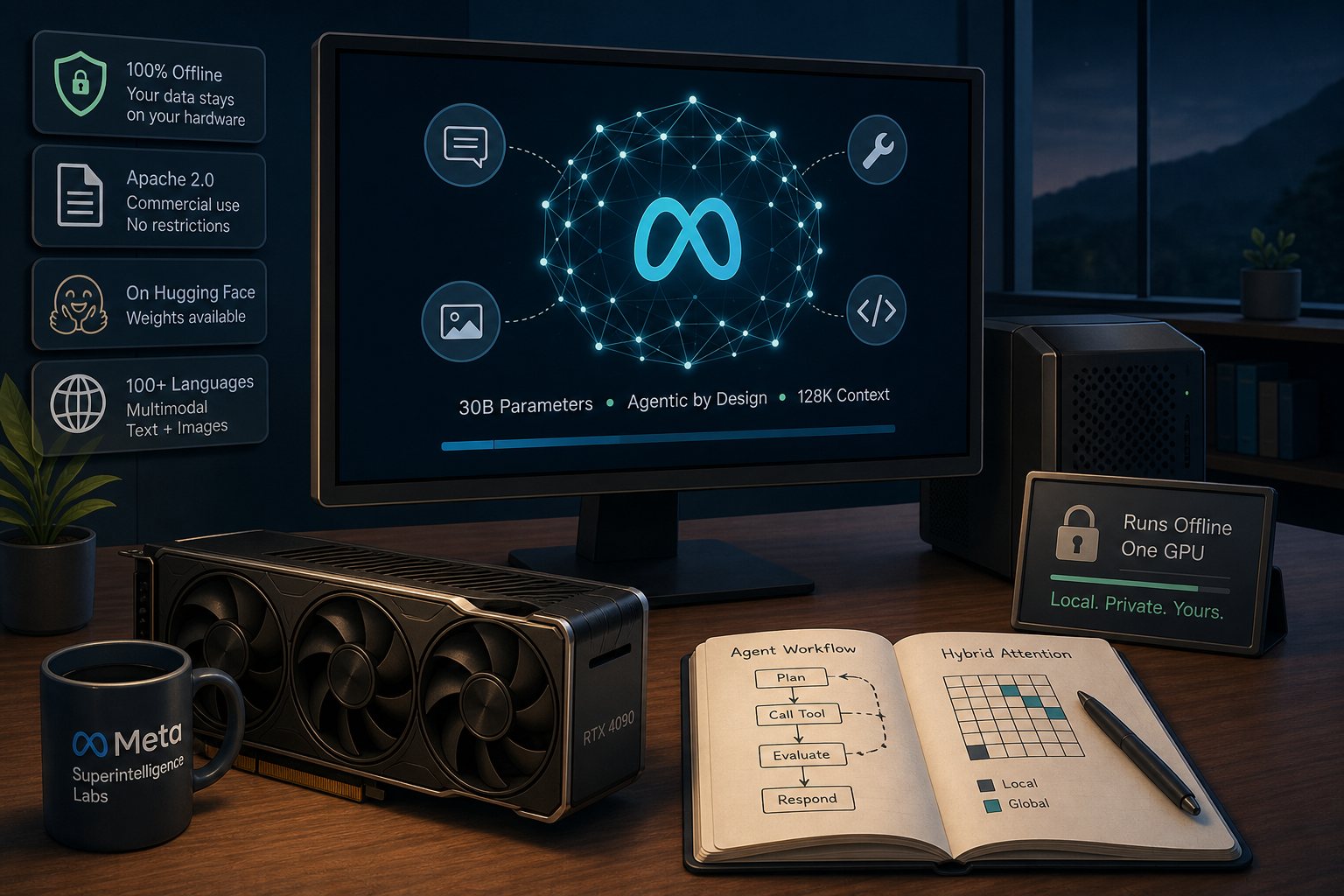
On August 10, 2026, Meta Superintelligence Labs shipped Muse Glimmer: a 30-billion-parameter multimodal model, Apache 2.0 licensed, weights on Hugging Face, and capable of running fully offline on a single consumer GPU. For businesses that have been watching AI closely but keeping cloud APIs at arm's length — over cost, privacy, or vendor dependency — this release is worth a serious look.
Why This Release Is Different
Meta's relationship with open-source AI has been rocky. The Llama 4 launch earlier this year landed poorly — benchmarks disappointed, the developer community felt misled about license terms, and Meta's AI group went through a visible restructuring. Muse Glimmer, built by the newly branded Meta Superintelligence Labs, is being positioned as a reset. The Apache 2.0 license is the clearest signal: no usage restrictions, no “non-commercial only” carve-outs, no geographic limitations. You can build a commercial product on top of it today.
The model itself is distilled from Muse Spark, Meta's proprietary frontier model, rather than trained from scratch in the traditional sense. That lineage shows in what it's optimized for: Glimmer was trained on agentic traces from the beginning, not retrofitted with tool-use instructions post-hoc. That distinction matters in practice — the model reasons through multi-step tasks, recovers when a tool call fails, and handles long sessions without falling apart the way instruction-tuned general models tend to when chained tool calls stretch beyond a few turns.
Capabilities Worth Noting
Glimmer accepts interleaved text and images through a bundled ~1.8B-parameter vision encoder, handles more than 100 languages, and carries a 128,000-token context window with a hybrid attention design that keeps latency manageable on longer inputs. Its stated strengths are function calling and tool orchestration — tested on the Tau3-Banking agentic benchmark suite — plus local coding assistance and LLM-as-a-judge workflows. Controllable reasoning effort lets you dial down compute for fast tasks and dial up for complex ones, a feature that matters when you're running inference on your own hardware and every token costs wall-clock time.
Knowledge cutoff is January 4, 2026, so anything that happened since then is outside its training data. That's not unusual for a model of this vintage, but it's worth factoring in if you're building anything that needs current events or recent documentation.
What Running It Actually Requires
Full BF16 precision lands at roughly 55–60 GB — that's RTX Pro 6000 or AMD MI350P territory. For most teams, the practical path is 4-bit quantization, which brings the model down to approximately 16–20 GB and makes it viable on an RTX 3090 or 4090. Meta's bundled DFlash speculative decoding drafter reportedly hits 3.1× faster throughput on an RTX 5090 — around 75–233 tokens per second depending on load. On a more typical consumer setup, expect roughly 12 tokens per second, which is usable for batch processing and background agent tasks but not interactive chat at scale.
Ecosystem support is solid at launch: Ollama, vLLM, llama.cpp, MLX, and ExecuTorch integrations are available or landing within days. If you have a machine already running local LLM inference, Glimmer slots in without infrastructure changes.
Honest Benchmark Positioning
Artificial Analysis puts Glimmer at position 35 on their Intelligence Index — trailing Qwen3.6-27B (38) and Kimi K2.5 (36) but scoring well on openness metrics. Against direct competitors in the open-weight 27–31B tier, Meta's benchmarks show Glimmer outperforming Google's Gemma 4 31B across most tasks, with a more mixed picture against Alibaba's Qwen 3.6-27B. Hallucination control and knowledge calibration are cited as relative weaknesses. Alibaba is expected to counter with Qwen 3.8-27B soon, so the benchmark race in this tier is still live.
The honest framing: Glimmer is not a frontier model. It won't outperform frontier cloud models on reasoning-heavy tasks. What it offers is a genuinely capable, commercially-licensed agent runtime that costs nothing per token and leaves your data on your own hardware.
The Business Case for Local AI Agents
For small and mid-size businesses, the most compelling aspect isn't the benchmark position — it's the operational profile. A locally-running agent with Apache 2.0 licensing means no per-token costs, no data leaving your network, no dependency on a cloud provider's uptime or pricing changes, and no usage policy review every time your use case evolves. Document processing, internal knowledge retrieval, customer ticket triage, code review pipelines — all of these are workloads that a 30B quantized model running on a $1,200 GPU can handle, and handle continuously, without a cloud invoice attached.
The offline capability is particularly meaningful for businesses in regulated industries or those handling sensitive client data. Glimmer can run air-gapped. That changes the risk calculus for anyone who's been eyeing AI automation but stalled on data-handling concerns.
We've watched local inference go from a novelty to a serious operational option over the past two years. Muse Glimmer is the first model in the 30B tier that arrives with an agentic-first design, a commercial-grade license, and a realistic hardware story for teams that aren't running a GPU cluster. Meta still has ground to make up on frontier benchmarks, but for the local agent use case, the bar just moved.