
Eight Hours Dark: GitHub's Global Outage Consumed a Year of Downtime Budget in One Day
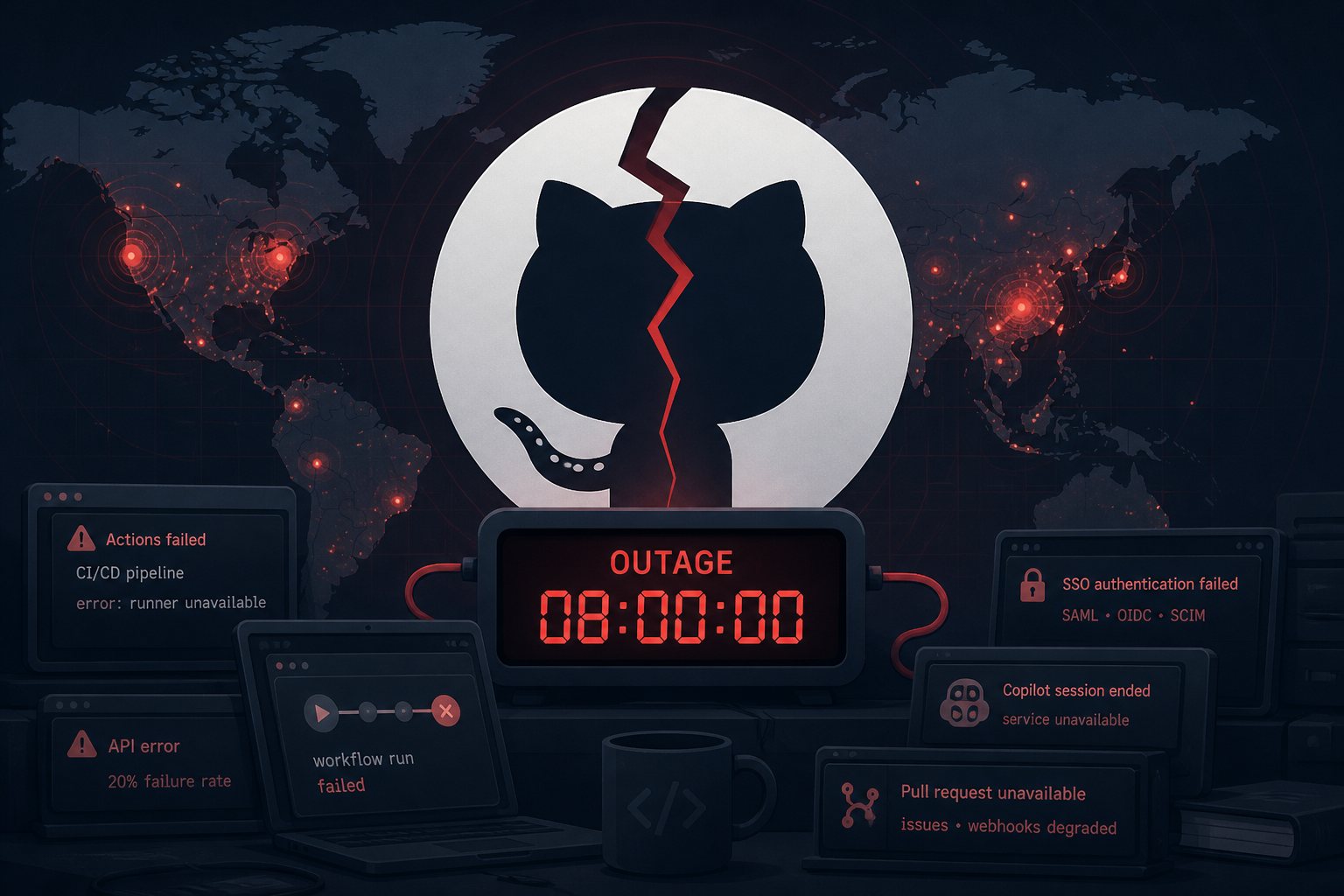
At 9:40 a.m. EDT on August 17, GitHub began failing worldwide. By the time the platform stabilized — roughly eight hours later — developers had watched CI/CD pipelines stall, Copilot sessions drop, and pull requests lock up across every major service the platform offers. Microsoft confirmed the incident but had not publicly disclosed a root cause as of Tuesday.
What Actually Went Down
Nearly every layer of the platform was affected simultaneously. GitHub Actions — the CI/CD engine that runs automated builds, tests, and deployments for millions of projects — was unreliable for the duration. API requests returned errors at roughly a 20% rate. Archive downloads and raw repository content were worse: approximately 50% of those requests failed. Authentication via SAML, OIDC, and SCIM broke, locking out teams using enterprise single sign-on. GitHub Copilot, the AI coding assistant baked into most modern dev workflows, went dark alongside everything else. Pull requests, issues, and webhooks were all degraded.
In short: if your team relies on GitHub for anything beyond a local git clone, it did not work reliably for most of the workday on Monday.
The Downtime Math Is Striking
GitHub Actions had been running at 99.33% availability over the previous 90 days — equivalent to just over 14 hours of cumulative downtime across that window. Monday's eight-hour incident alone consumed roughly the equivalent of a full year's worth of three-nines downtime budget in a single event. For context, three nines (99.9%) allows about 8.76 hours per year. One incident. One day.
This was not an isolated slip. GitHub logged 257 separate outage events in the twelve months leading up to August — a figure that points to systemic stress on infrastructure that now underpins an enormous slice of global software development. The platform hosts roughly 180 million users. When it stumbles, the ripple is wide.
The Cursor Origin Launch Was Hard to Ignore
Cursor — the AI-first code editor recently acquired by SpaceX for $60 billion — chose August 17 to launch Origin, its new code-hosting platform that positions itself directly against GitHub. Cursor cited GitHub's 257 outages over the past year and a roughly 20% recent API error rate as evidence that developer infrastructure deserves more competition.
Origin adds repository hosting, pull requests, and code review to Cursor's existing editor, with day-one integrations for Vercel, Depot, and Buildkite. It is designed to sync with existing GitHub repos rather than force an immediate migration — a realistic on-ramp for teams that will not abandon GitHub overnight. Agent-native features, workflows built around AI agents rather than human-first UI, are planned in subsequent releases. Whether the same-day timing was strategy or serendipity, it landed during a live GitHub outage and the contrast was impossible to miss.
Origin is real, but early. GitHub has 18 years of network effects, integrations, and tooling behind it. Teams will not migrate because of one bad Monday. But Cursor now has a credible on-ramp for the teams already using its editor who want less platform lock-in.
What This Means If Your Website Deploys Through GitHub
For small and mid-size businesses, the practical exposure depends on how tightly your deployment pipeline is coupled to GitHub. If you push to a GitHub repo and Actions triggers an automatic deploy — to a static site CDN, a staging environment, a WordPress theme — Monday meant those deploys queued and stalled. If your team uses Copilot day-to-day, that went dark too. If your enterprise plan relies on SAML-based SSO anchored to GitHub, some engineers could not authenticate at all.
The lesson is not to abandon GitHub. It is to know what you would do if it disappeared for a workday. A few practical steps:
- Test your manual deploy path now, before you need it. If you cannot ship without Actions running, you have no fallback. Write runbooks that assume GitHub is unavailable.
- Do not chain critical production changes to a fully automated pipeline with no human gate. A partially-degraded API response can fire a webhook at the wrong moment — or not at all.
- Mirror important repositories to a second remote. A self-hosted Gitea instance, GitLab, or even a local bare clone means you can push and pull even if github.com is timing out.
- Audit your authentication dependencies. If GitHub is your SSO anchor via OAuth, a GitHub outage becomes a login outage for your internal tools. Confirm your toolchain has a fallback auth path.
The Bigger Picture
The web has quietly consolidated around a handful of large platforms for its plumbing — GitHub for code, Cloudflare for DNS and CDN, AWS and Azure for compute. That consolidation delivers real benefits, but it also means single-platform failures now carry blast radii that did not exist a decade ago. Monday was a reminder that "the cloud" is still physical infrastructure operated by humans, and humans make mistakes.
At Falcon Internet, eight-hour platform outages are exactly why independent monitoring and deployment workflows matter. The NOC watches continuously — but the architecture has to handle the reality that upstream dependencies fail.