
CVE-2026-133469: empty cookie logs attackers into Xen Orchestra
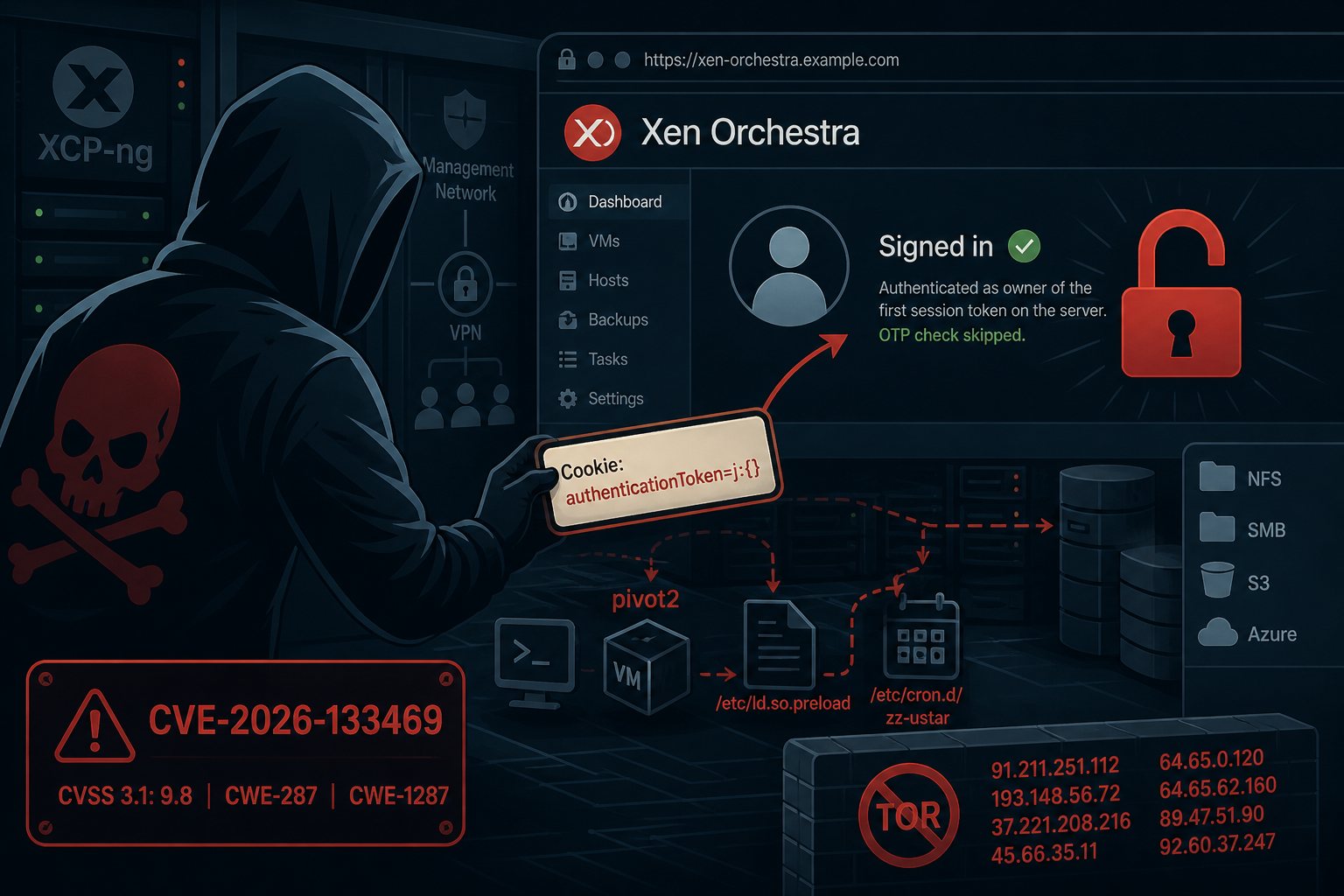
CISA added CVE-2026-133469 to its Known Exploited Vulnerabilities catalog on November 25, 2026, and gave federal agencies until November 28 to fix it. The flaw is in Xen Orchestra, the web console Vates ships for managing XCP-ng and XenServer pools. An attacker with no credentials who can reach the console sends a cookie holding an empty JSON object and is signed in as the owner of the first session token stored on the server. Vates says a threat actor is exploiting it and has published indicators of compromise.
The bug carries a CVSS 3.1 score of 9.8 and is classed as CWE-287 and CWE-1287. Vates released the fix with advisory VSA-2026-062 on November 10. GitHub advisory GHSA-2r3w-c2vx-fv5g followed on November 20 and the CVE record on November 23, so the vulnerability was public for close to two weeks before most scanners and feeds had an ID to track. A console that has not been updated since early November should be treated as possibly compromised until it has been checked.
Affected and fixed versions
- Stable channel: every Xen Orchestra release before 6.9.2 is affected. The fix is 6.9.2, which ships xo-server 5.211.2.
- Latest channel: 6.10.0 is affected. The fix is 6.10.1, which ships xo-server 5.213.1.
- Xen Orchestra Appliance (XOA): affected. Update through the appliance updater to either fixed release.
- Installs built from source: pull current master, which contains commit 50166fe ("validate authentication token IDs"), and rebuild.
How an empty cookie becomes a valid session
Xen Orchestra's server runs on Express, and its cookie parser treats any value that starts with j: as JSON. A request carrying authenticationToken=j:{} therefore reaches xo-server as an empty object instead of a token string. The authentication check only tested whether the value was truthy, and an empty object is. The code then passed that object to the token store's lookup, and the Redis-backed collection treats an empty filter as "match everything" and returns the first token ID in the set.
If that token has not expired, xo-server accepts the request as the token's owner and flags the session to skip the one-time-password check, so two-factor authentication on the account does not stop it. The attacker cannot choose which account they land in, and the request fails if the first token is expired. On a small deployment the only people with sessions on a hypervisor console are usually administrators and service accounts, so the odds favor the attacker. The fix rejects any token ID that is not a non-empty string.
Console access gives the attacker the hosts and the backups
Xen Orchestra stores the pool credentials for every connected host, creates and starts VMs, runs backup jobs, and keeps the credentials for backup remotes on NFS, SMB, S3 and Azure. The indicators in VSA-2026-062 show the attacker moving from the console onto the XCP-ng hosts: a VM named pivot2, VMs configured with hvm_serial: file, an /etc/ld.so.preload file, and cron entries under /etc/cron.d. Those last two are standard Linux persistence locations, which means a patched console does not clean up hosts that were already reached.
Indicator checks from VSA-2026-062
Vates notes that xo-server writes no log entry for unauthenticated access, so the cookie itself only shows up in network captures or in a reverse proxy configured to log the Cookie header (default nginx and Apache formats do not). Look for either form:
authenticationToken=j:{}
authenticationToken=j:%7B%7D
In the Xen Orchestra VM list, look for a VM named pivot2. From any pool member you can also run:
xe vm-list name-label=pivot2On every XCP-ng host in every pool the console manages, run:
zgrep -- '-serial file:' /var/log/xensource.log*
ls -la /etc/ld.so.preload /.ustar* /etc/cron.d/zz-ustar*
The first command finds VMs started with their serial console redirected to a file on the host. The second should return "No such file or directory" for every path. The specific files Vates lists are /etc/cron.d/zz-ustar, /etc/cron.d/zz-ustar2, /.ustar5 and /.ustar6.
Block these addresses inbound and outbound at the firewall, and block Tor egress from the management network:
91.211.251.112   193.148.56.72   37.221.208.216   45.66.35.11
64.65.0.120      64.65.62.160    89.47.51.90      92.60.37.247
Vates lists 91.211.251.112 on port 8001 and an onion service on port 3333 as the attacker's starting points.
Cleanup after a positive match
Vates recommends a full reinstall of Xen Orchestra rather than cleanup, because removing known files cannot guarantee that every backdoor is gone. After reinstalling, rotate every secret the console held:
- Host root passwords and the pool secret
- Xen Orchestra user passwords and OTP secrets
- Credentials for XO proxies
- Credentials for backup remotes (NFS, SMB, S3, Azure)
- Mail server passwords used for backup reports
The advisory scopes the reinstall to Xen Orchestra. If the host-level checks above turn up anything, we would also rebuild those XCP-ng hosts from install media and restore VMs from a backup taken before the earliest indicator, after confirming the backup remote itself was not altered.
Keep virtualization consoles on a management network
Vates' standing advice is to keep Xen Orchestra off the internet and on a dedicated management network reached by VPN or a source-IP allow list. The same placement would have limited exposure to the vCenter flaw CVE-2026-123890 earlier this month, and we keep hypervisor consoles for client environments off public addresses for this reason. Where a console has to stay reachable until it can be patched, a WAF or reverse-proxy rule that rejects the two cookie strings above is a stopgap only. Vates warns the rule can be bypassed with other encodings of the same value.