N-able Mail Assure CVE-2026-134624 exploited; fix is build 20261121.1943
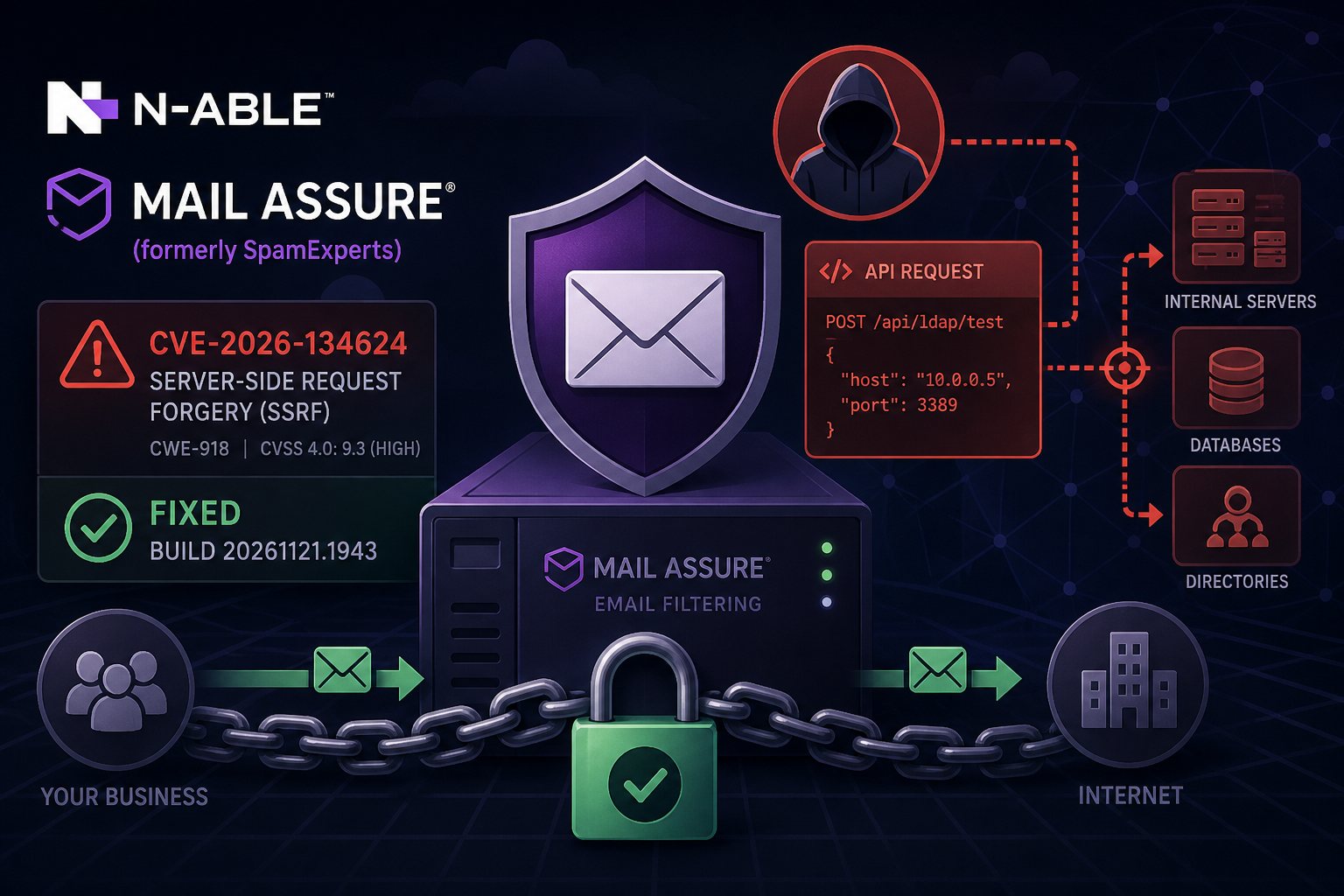
N-able has fixed a server-side request forgery flaw in Mail Assure, the email filtering service also sold as SpamExperts, that it found while investigating a breach of its own hosting. The bug is tracked as CVE-2026-134624 and is fixed in build 20261121.1943. CISA added it to the Known Exploited Vulnerabilities catalog on November 23 and gave federal agencies until November 26 to act.
Mail Assure is sold mainly through managed service providers, who resell it to small and mid-size businesses as an inbound and outbound spam filter. If your mail passes through it, your provider should already be dealing with this. The customer side of the work is mostly about API credentials.
Timeline from N-able and press reports
- Mid-November: N-able disabled the Mail Assure dashboard and API. SecurityWeek dates the shutdown to November 16; Ostorlab's timeline puts the management interfaces going offline on November 18, the day N-able confirmed an attack.
- November 18 to 21: N-able told SecurityWeek that attackers reached a web server and likely accessed credentials stored on it. The company changed credentials and revoked API and OAuth tokens.
- November 21, 23:45 UTC: dashboard and API access restored after the fix was deployed.
- November 22: N-able published CVE-2026-134624 and an incident update stating that inbound and outbound mail flow and spam filtering kept running throughout.
- November 23: CISA added the CVE to the KEV catalog.
N-able says it has found no evidence of exploitation beyond the single N-able-hosted server identified early in the investigation. It has not said whether this CVE was how the attackers got in, has not named a threat actor, and has published no indicators of compromise. An independent incident response firm is involved, and N-able has promised a root cause analysis within two weeks of November 22.
The LDAP sync connection check
Mail Assure can synchronize with a customer's LDAP directory when a mail relay is configured, and it runs a connection check against the directory server the user enters. That check did not limit where it would connect. An API user with enough privileges could point it at any internal host and port, learn which ones answered, and send crafted data to internal services. The weakness is classed as CWE-918.
N-able scores it 9.3 under CVSS 4.0. The vector marks privileges required as high, so an anonymous visitor cannot use it. The danger comes from what sits around it: a breach in which credentials were likely taken, and a multi-tenant service whose internal network is reachable from the filtering hosts. Anyone holding privileged API credentials lifted from that web server would meet the requirement.
Hosted customers versus self-hosted Local Cloud nodes
N-able deployed the fix to its hosted infrastructure on November 21, so Hosted Cloud tenants have nothing to install. Coverage of self-hosted SpamExperts Local Cloud deployments is inconsistent. Some write-ups say every self-hosted node needs build 20261121.1943 now; others point out that the N-able text they read does not say who applies the build outside N-able's own servers. If you or your provider run filtering nodes on your own hardware, ask N-able directly and check the build number on each node rather than assuming either way.
Checks for businesses and resellers using Mail Assure
- Reissue API credentials. N-able revoked API and OAuth tokens during the incident. Billing systems, control panel add-ons and provisioning scripts that call the Mail Assure API will fail authentication until they get new credentials. Treat any token or password that existed before November 21 as exposed, including ones you have not yet noticed failing.
- Audit API users. List every API account at the reseller and domain level. Remove accounts nobody can identify, and drop privileges on the rest to what each integration needs. The flaw requires a privileged API user, so fewer of those means less to steal next time.
- Review relay and LDAP settings. Look at each domain with a relay and LDAP sync configured. The directory host should be one of your servers. An unfamiliar IP address, a private address range you do not use, or a port other than 389 or 636 is worth investigating.
- Restrict outbound traffic from self-hosted nodes. A filtering node should reach your directory servers on LDAP ports, your mail servers on SMTP, and N-able's update and management endpoints. Block the rest at the firewall, including the 169.254.169.254 metadata address if the node runs in a public cloud.
- Keep logs. Preserve Mail Assure audit logs, firewall logs and mail server logs from at least November 1. When the root cause analysis arrives it may include indicators you will want to search for, and log rotation will have removed them by then.
- Confirm mail delivery. N-able says filtering never stopped. A quick check of quarantine volumes and delivery logs for the incident window will tell you whether anything was held or dropped on your domains.
Email filtering services hold MX records, delivery routes and often directory credentials for every domain they protect, so their API keys deserve the same handling as a domain registrar login. We keep an inventory of which systems hold which third-party API keys for the mail and DNS services we manage, so a vendor-wide token revocation like this one becomes a short list of credentials to reissue.